 info@rkgindustries.com
  +91-7419008652, +91-9355108652
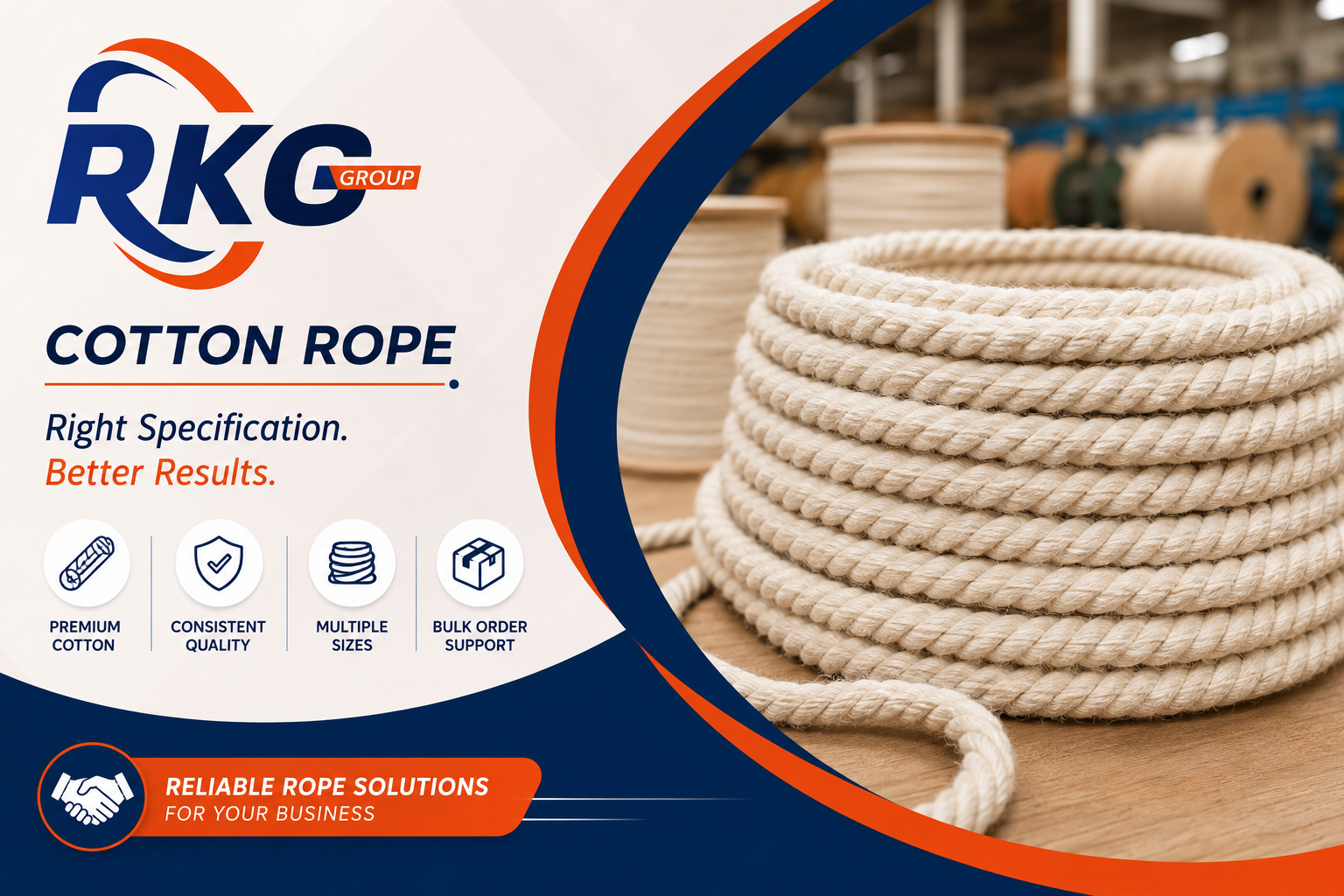
If you are buying cotton rope in bulk, diameter is probably one of the first specifications you check. A buyer may ask for 4 mm, 6 mm, 8 mm or 10 mm rope and then compare quotations from different suppliers. But there is a problem with this approach.Two cotton ropes with the same stated diameter can still behave differently in actual use.
The difference can come from the rope construction, yarn quality, strand formation, finishing, flexibility and manufacturing consistency. This becomes particularly important when rope is being purchased in hundreds or thousands of metres for commercial production.
That is why choosing the right Cotton Rope Manufacturers in India should involve more than comparing rope diameter and price.
Why Cotton Rope Diameter Alone Can Be Misleading
The diameter tells you the approximate thickness of the rope. It does not tell you everything about how that rope has been made.
For example, two suppliers may quote an 8 mm cotton rope. On paper, both products appear identical. However, once samples are compared, you may notice differences in:
- Surface appearance
- Softness and flexibility
- Strand structure
- Compactness
- Overall feel
- Finish
- Dimensional consistency
- Performance in the intended application
For a small one-time purchase, these differences may not be critical.
For a bulk order, they can become much more noticeable because the rope is being used repeatedly across a large number of finished products.
This is why the specification should describe the rope as a complete product rather than only mentioning its diameter.
What Should Be Considered Along With Diameter?
When discussing a cotton rope requirement with a manufacturer, look beyond the size.
| Specification | Why a Bulk Buyer Should Care |
| Diameter | Determines thickness and suitability for the application |
| Construction | Affects structure, flexibility and appearance |
| Yarn quality | Influences surface consistency and overall rope quality |
| Strand formation | Can affect handling and finished appearance |
| Finish | Important where the rope remains visible or is handled frequently |
| Colour | Relevant for product matching and branding |
| Length | Helps calculate actual material requirements |
| Packaging | Matters for storage, handling and transportation |
| Batch consistency | Important for repeat production and reorders |
The exact importance of each specification depends on how the rope will be used.
A rope intended for decorative handles, for example, may be judged heavily on appearance and feel. A rope used as part of a production process may have different priorities.
Braided or Twisted? Construction Changes the Product
Another detail that often gets overlooked is rope construction.
Cotton rope can be produced in different constructions, including braided and twisted forms. These constructions do not necessarily provide the same appearance or handling characteristics.
Braided Cotton Rope
Braided construction can provide a structured appearance and a different surface feel compared with twisted rope. It can be considered for applications where appearance, flexibility and construction are important.
Twisted Cotton Rope
Twisted rope has a more traditional strand-based appearance. Depending on its construction and specification, it can be suitable for various packaging, craft, decorative and general-purpose requirements.
The point is not that one construction is universally better.
The important question is:
Which construction matches your actual application?
If you simply tell a supplier, “I need 6 mm cotton rope,” you may still need to clarify whether you require braided or twisted construction.
The Same Diameter Does Not Guarantee the Same Feel
This is one of the most important things to check when comparing samples.
Suppose you receive two samples marked as the same diameter. One may feel softer and more flexible, while another may feel more compact or rigid.
That difference can matter when the rope is:
- Used as a handle
- Wrapped around a product
- Used for decorative purposes
- Incorporated into a finished article
- Cut into fixed lengths
- Handled repeatedly during production
The finished product may look different even though both ropes have been sold under the same diameter specification.
For this reason, sample approval should be based on the actual application, not just a ruler or measuring instrument.
Why Yarn Quality Matters in Cotton Rope
The rope is only as good as the material and manufacturing process used to make it.
Cotton yarn quality can influence the appearance and consistency of the finished rope. Differences in yarn characteristics can become more visible when rope is produced in large quantities.
For a buyer, the practical question is not simply:
“Is it cotton?”
The better questions are:
- Is the yarn suitable for the intended rope?
- Is the surface consistent?
- Is the rope construction uniform?
- Does the sample match the required finish?
- Can the same specification be repeated in future orders?
These questions become particularly important when the rope forms part of a branded or finished product.
Bulk Buying Makes Consistency More Important
A sample can look perfect and still leave an important question unanswered:
Will the next 5,000 or 10,000 metres look and perform the same way?
This is where the difference between a casual supplier and a dependable manufacturer becomes important.
For bulk procurement, buyers should consider:
- Consistency within the current batch
- Consistency between repeat orders
- Ability to maintain the agreed specification
- Packaging and identification of finished material
- Communication regarding changes or custom requirements
If you are producing hundreds of items using cotton rope, even a small difference in rope appearance can become obvious across the finished batch.
Don’t Compare Cotton Rope Manufacturers Only on Price
Price per metre is easy to compare.Product quality is not. Imagine Supplier A offers cotton rope at a lower rate, while Supplier B offers a slightly higher rate but provides the exact construction, consistent dimensions and finish required for your product.
If Supplier A’s rope causes more wastage, requires additional sorting or does not give the desired finished appearance, the initial saving may disappear.
A better comparison looks at the total value of the material, not just the quoted rate.
| What to Compare | Why It Matters |
| Price per metre | Determines basic material cost |
| Actual specification | Ensures you are comparing equivalent products |
| Sample quality | Shows whether the rope suits your application |
| Consistency | Reduces variation during production |
| Packaging | Helps with handling and storage |
| Bulk capability | Important for larger requirements |
| Repeat-order consistency | Critical for long-term sourcing |
This approach gives a much clearer picture when evaluating Cotton Rope Manufacturers in India.
What Should You Send a Manufacturer Before Asking for a Quote?
Material: Cotton
Construction: Braided / Twisted
Diameter: 6 mm
Colour: Natural / specified colour
Quantity: Required metres
Application: Product handles / packaging / craft / other
Packing: Required packing format
Sample: Required before bulk production
If you already have a sample, photograph or existing specification, sharing it can make the discussion much easier.
This also allows different manufacturers to quote against the same requirement.
What Should You Check in the Sample?
Before approving a bulk order, don’t inspect the sample only for colour.
Look at the complete product.
Check the diameter
Measure the rope at multiple points rather than checking only one section.
Check the construction
Look closely at the braid or twist. The structure should match what was requested.
Check the surface
Look for visible irregularities, unwanted loose fibres or noticeable changes in appearance.
Check flexibility
Handle the rope in the same way it will be used in your product.
Check the finish
If the rope will remain visible, its surface appearance can be just as important as its dimensional specification.
Check the actual application
This is perhaps the most important test.
A rope that looks excellent on a table may not necessarily be the best choice once it is fitted into your finished product.
Why Indian Buyers Should Look at Manufacturing Capability
When choosing among Cotton Rope Manufacturers in India, buyers should consider whether the supplier can support the complete requirement—not just supply one sample.
Look for evidence of:
- Relevant rope manufacturing experience
- Suitable production capability
- Consistent product specifications
- Quality checking procedures
- Bulk-order handling
- Customisation where required
- Reliable communication
- Repeat-order support
For a business that expects regular purchases, this matters considerably more than finding a supplier for a single small order.
RKG Industries for Rope and Yarn Requirements
RKG Industries manufactures and supplies rope and yarn products for commercial requirements. For buyers evaluating a cotton rope requirement, the practical starting point is to share the required diameter, rope construction, quantity, application and preferred finish. This helps establish the appropriate product specification before moving toward bulk supply.
Rather than selecting a rope solely on its quoted diameter, buyers can discuss the complete requirement with RKG Industries and confirm the available specification before placing an order.
Conclusion
When purchasing cotton rope in bulk, diameter is only one part of the overall specification. Rope construction, yarn quality, surface finish, flexibility, and batch-to-batch consistency can all influence its performance and the appearance of the finished product.
Therefore, when evaluating Cotton Rope Manufacturers in India, the focus should not be limited to the price of a particular diameter, such as 6 mm. Instead, buyers should assess whether the manufacturer can consistently supply the required rope specification according to the application.
A clear understanding of these factors helps buyers compare manufacturers on quality and suitability rather than price alone. It also reduces the risk of specification variations and makes the transition from sample approval to regular bulk production more reliable.
Frequently Asked Questions
1. Is cotton rope diameter enough to compare different manufacturers?
No. Diameter is an important specification, but it does not describe construction, yarn quality, finish, flexibility or overall consistency. These factors should also be considered when comparing products.
2. Can two 8 mm cotton ropes be different?
Yes. Two ropes sold as 8 mm can differ in construction, surface, flexibility, strand formation and overall feel. This is why comparing physical samples is useful before a bulk order.
3. Should I choose braided or twisted cotton rope?
That depends on your application. Consider how the rope will be handled, how it needs to look, how flexible it should be and how it will be incorporated into the final product.
4. What information should I provide when requesting a bulk quotation?
Provide the material, diameter, construction, colour, quantity, application and packaging requirement. If you have a sample or existing specification, share that as well.
5. Why is sample approval important for bulk cotton rope orders?
A sample allows you to check whether the rope actually matches your application before committing to a large quantity. It is especially useful for checking diameter, construction, appearance, flexibility and finish.