 info@rkgindustries.com
  +91-7419008652, +91-9355108652
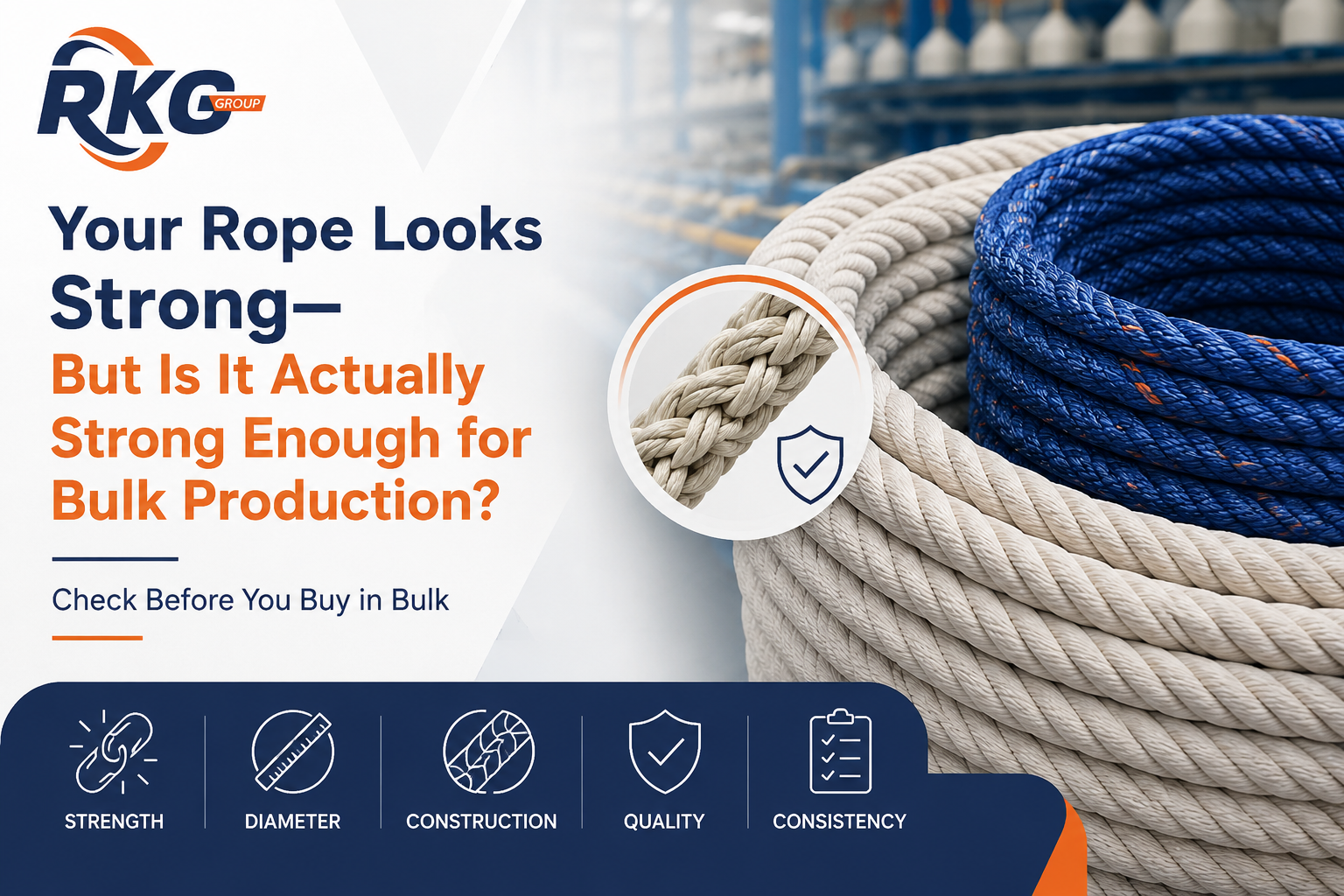
A rope sample can look thick, tight and well-finished on the table. That does not automatically mean it will perform the same way when you order thousands of metres.For bulk production, rope strength is only one part of the decision. The material, yarn quality, rope construction, diameter consistency, flexibility, abrasion resistance and manufacturing control can all affect how the rope performs from one batch to the next.
This is why businesses looking for Rope Manufacturers in India should evaluate more than a sample that simply “feels strong.” The better question is: Will the rope maintain the required performance throughout the quantity you are buying?
What Does “Strong Enough” Actually Mean for a Rope?
Rope strength is not simply about how much force a new piece can withstand before breaking. For a bulk buyer, performance may also depend on:
- Required breaking strength
- Working load requirements
- Rope diameter
- Material and yarn construction
- Braided or twisted construction
- Flexibility and handling
- Resistance to abrasion
- Exposure to moisture, friction or repeated use
- Consistency between production batches
A rope may pass a basic strength test and still be unsuitable for a particular application if it does not provide the right combination of these characteristics.
Breaking Strength Is Not the Same as Working Performance
One of the most common mistakes is treating the maximum breaking point as the normal operating capacity. Breaking strength indicates the force at which the rope fails under a defined test condition. The actual load a rope should handle during use can be much lower, depending on the application, safety requirements, rope construction and operating conditions. Therefore, a buyer should not select a rope only by asking: “How many kilograms can this rope hold?” Instead, ask: “What performance does this rope need to deliver in my actual application?”
Why a Thick Rope Is Not Automatically a Stronger Rope
A larger diameter can provide greater material cross-section, but diameter alone does not tell the complete story.
Two ropes may have a similar diameter but different:
- Yarn quality
- Fibre composition
- Yarn count
- Braiding pattern
- Number of strands
- Construction density
- Manufacturing consistency
- Finishing
As a result, their performance can be different.
This matters particularly when comparing quotations from different Rope Manufacturers in India. If one supplier quotes a lower price for a similar-looking diameter, do not compare the price alone. Compare the complete rope specification.
6 Things to Check Before Approving a Rope for Bulk Production
1. Start With the Actual Application
Before discussing price, tell the manufacturer exactly where the rope will be used.
A rope intended for:
- Packaging
- Handles
- Pet products
- Decorative products
- Industrial applications
- Agriculture
- Outdoor use
- General tying
- Manufacturing components
may require different characteristics. For example, a flexible rope may be more important for one application, while abrasion resistance or higher tensile performance may matter more for another. Application should determine specification—not the other way around.
2. Check the Rope Material
The raw material directly influences how a rope behaves.
Common rope materials include:
A. Cotton
Cotton rope is generally selected where softness, natural appearance and comfortable handling are important.
B. Polyester
Polyester ropes are widely considered when durability, strength, dimensional stability and resistance to environmental conditions are required.
C. Polypropylene
Polypropylene is often selected where lightweight construction and cost efficiency are important.
The correct material depends on the application. There is no single rope material that is best for every bulk order.
3. Look at Rope Construction—Not Just the Material
Saying “polyester rope” or “cotton rope” does not provide the complete specification. You also need to know how the rope is constructed.
Braided Rope
Braided Rope construction can provide a smooth appearance and controlled structure. Depending on the design, it may also offer good flexibility and handling characteristics.
Twisted Rope
Twisted rope is produced by twisting yarns or strands together. Its construction, twist level and strand arrangement can influence handling and performance.
The choice between braided and twisted rope should be based on what your finished product actually requires.
4. Check Diameter Consistency
This is particularly important when the rope becomes part of another manufactured product.Suppose you order 20,000 metres of rope. The first few rolls look perfect.
But later rolls have noticeable differences in diameter.
That variation can create problems in:
- Automated production
- Cutting
- Stitching
- Fitting
- Packaging
- Product appearance
- Final assembly
For this reason, diameter consistency across the batch can be just as important as strength.
A rope manufacturer should have suitable production and inspection controls to maintain the specified dimensions.
5. Ask for Relevant Strength Information
Do not settle for a statement such as: “Our rope is very strong.” Ask for measurable specifications relevant to your application.
Depending on the rope and its intended use, you may need information such as:
- Tensile or breaking strength
- Diameter
- Material
- Construction
- Weight per metre
- Length per roll
- Available sizes
- Finish
- Batch consistency
If the application is load-bearing or safety-critical, additional engineering assessment and appropriate testing may be necessary.
A Better Way to Compare Suppliers
Instead of asking three manufacturers:
“What is your price for 10 mm rope?”
send all three the same specification.
For example:
Material: Polyester
Construction: Braided
Diameter: 10 mm
Application: [Your application]
Required quantity: 10,000 metres
Required performance: [Your requirement]
Packaging: [Your requirement]
Now you are comparing suppliers on a much more meaningful basis.
6. Check Whether the Manufacturer Can Maintain the Same Quality at Scale
This is where bulk production becomes different from buying a small quantity.
A supplier may provide an excellent sample.
The important question is:
Can the manufacturer reproduce that specification consistently across the entire order?
When evaluating Rope Manufacturers in India, ask about:
- Production capacity
- Manufacturing process
- Quality inspection
- Batch consistency
- Packaging
- Custom specifications
- Repeat-order capability
- Lead time
- Sample approval process
You are not only buying rope.
You are buying consistency across a production quantity.
What Should You Include in Your Rope Purchase Specification?
Before requesting a bulk quotation, prepare a clear specification.
| Specification | What to Mention |
| Material | Cotton, polyester, polypropylene, nylon, jute, etc. |
| Construction | Braided or twisted |
| Diameter | Required diameter in mm |
| Application | Where and how the rope will be used |
| Quantity | Total metres / rolls / pieces |
| Colour | Required colour or natural finish |
| Finish | Smooth, natural or application-specific |
| Packaging | Roll, coil, bundle or other requirement |
| Strength | Required performance where applicable |
| Customisation | Any special manufacturing requirement |
This makes communication much easier between your purchasing team and the manufacturer.
When Should You Reject a Rope Sample?
A rope sample deserves further discussion if:
- Its diameter varies noticeably
- Construction appears uneven
- Fibres are loose or poorly finished
- The supplier cannot clearly explain its specification
- The sample does not perform in your application trial
- Strength information does not match your requirement
- The supplier cannot maintain the approved specification
- The quotation does not clearly define what you are receiving
A low price is not useful if the rope creates problems after entering production.
How RKG Industries Approaches Rope Manufacturing
At RKG Industries, rope requirements are approached around the actual application rather than treating every rope order as the same. The required material, construction, size, finish and quantity can influence the manufacturing specification. For bulk buyers, the objective should be straightforward:
Receive a rope that matches the agreed specification and performs consistently throughout the order.
Whether you are sourcing braided or twisted rope, the right starting point is a clearly defined requirement followed by sample evaluation and quality checks before bulk production. For businesses comparing Rope Manufacturers in India, this approach can make supplier evaluation much more practical.
Conclusion
A rope that looks strong is not necessarily the right rope for your production.
For bulk purchasing, strength, material, construction, diameter consistency, application performance and manufacturing consistency all need to work together.
The best way to evaluate Rope Manufacturers in India is therefore not to compare photographs or prices alone. Compare the actual specifications, test the sample in your process and confirm that the manufacturer can maintain the same requirements across the complete order. Because when you are buying thousands of metres, consistent performance matters far more than how strong the first sample looks.
Need Rope for Bulk Production?
If you are sourcing braided or twisted rope for manufacturing, packaging, industrial, commercial or customised applications, discuss your required material, diameter, construction and quantity with RKG Industries.
Frequently Asked Questions
1. How do I know if a rope is strong enough for bulk production?
Start with the actual application and determine the required performance. Then compare the rope’s material, construction, diameter, strength characteristics and sample performance against those requirements. For critical load-bearing applications, use appropriate testing and engineering guidance rather than relying only on appearance.
2. Is a thicker rope always stronger?
No. Diameter is important, but it is not the only factor. Material, yarn quality, construction, braiding or twisting, manufacturing consistency and other characteristics can affect rope performance.
3. What should I check when comparing Rope Manufacturers in India?
Compare the complete specification rather than price alone. Check material, construction, diameter, strength information, sample quality, manufacturing consistency, production capacity, packaging, lead time and the supplier’s ability to maintain the approved specification for repeat bulk orders.
4. Should I test a rope sample before placing a bulk order?
Yes. A sample should be evaluated against the actual requirements of your application. Where possible, test it in your production process and check dimensions, construction, handling and relevant strength characteristics.
5. What information should I send to a rope manufacturer for a quotation?
Provide the material, rope construction, diameter, application, required quantity, colour, finish, packaging requirements and any specific strength or performance requirement. A clear specification helps the manufacturer quote the correct product.