
 info@rkgindustries.com
 +91-7419008652, +91-9355108652
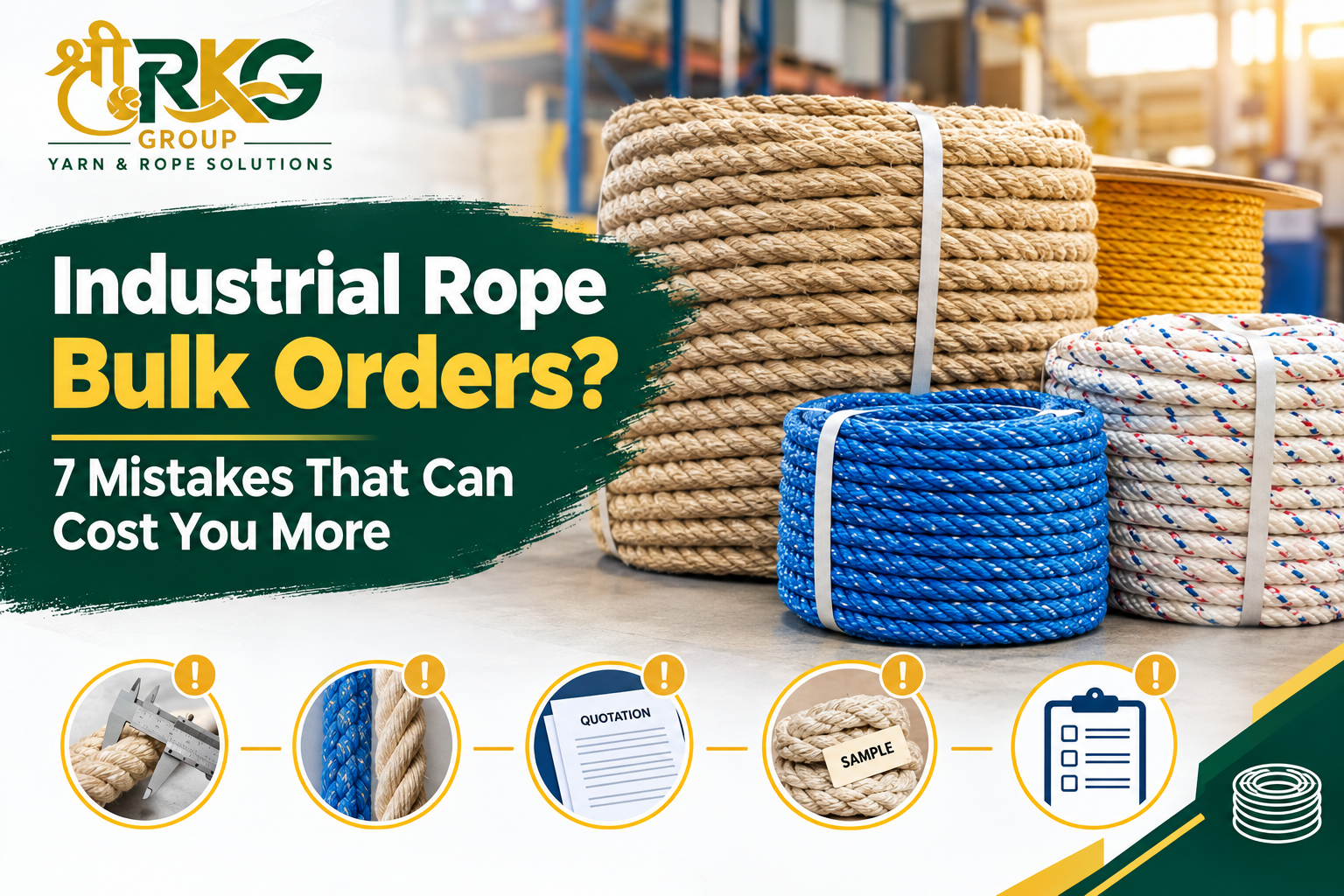
A rope supplier quotes a price per kilogram. Another quotes a price per coil. A third asks for the required diameter, material and construction before preparing the quotation.
For a business purchasing industrial rope in bulk, these quotations cannot be compared fairly until the actual product requirements are clear.
The problem becomes more serious when the rope is purchased for resale or regular production. If the delivered product differs from the buyer’s requirement, the business may face customer complaints, rejected stock or delays while arranging a replacement.
This is why businesses searching for Industrial Rope Manufacturers in India should settle the product specifications before negotiating the final price.
For RKG Industries, the relevant starting point is the buyer’s actual requirement: what the rope will be used for, which construction is needed, and what dimensions and supply quantities must be agreed upon.
Why Industrial Rope Orders Can Go Wrong Before Production Begins
Many purchasing problems start with incomplete product descriptions.
A buyer may request a particular diameter without specifying the material. Another may ask for a heavy-duty rope without explaining the working conditions. A distributor may reorder a previously purchased product using an old invoice that does not contain all the technical details.
Each situation leaves room for a difference between what the buyer expects and what the supplier understands.
Consider a packaging business ordering rope for bundling finished goods. If the replacement rope has a different surface texture or flexibility, workers may find that it handles differently from the previous supply. The diameter might be similar, but the product may not behave identically.
The practical solution is to describe the required rope by its specifications and application, not by a vague product name alone.
Before requesting quotations, prepare the following information:
- Intended application and working conditions.
- Braided or twisted construction.
- Required material.
- Nominal diameter and applicable tolerance.
- Required length, quantity and packaging.
- Any specific performance or inspection requirements.
These details give the manufacturer a clearer basis for discussing the order.
1. Ordering the Correct Diameter Is Not Enough
Diameter is one of the first specifications buyers consider, but it should not be the only one.
Two ropes with the same nominal diameter may differ in material, construction, flexibility and other characteristics. These differences can affect whether the rope suits the intended application.
For example, a rope intended to pass through a particular guide or fastening arrangement must fit that arrangement under the relevant operating conditions. Selecting a product by visual estimation alone may lead to an unsuitable purchase.
What Buyers Should Confirm
| Requiremet | What to Specify |
| Diameter | Required measurement in millimetres |
| Tolerance | Acceptable dimensional variation, where specified |
| Construction | Braided or twisted |
| Material | Required material or fibre specification |
| Application | How the rope will be used |
| Sample | Approved reference sample, if applicable |
For repeat orders, retain the approved specifications alongside the purchase order. This is more reliable than asking for the same rope by referring only to an earlier invoice.
2. Braided and Twisted Ropes Should Not Be Treated as Interchangeable
A buyer who requests industrial rope without specifying its construction may receive quotations for products that are not directly comparable.
Braided rope is made by interlacing strands or yarns. Twisted rope is formed by twisting strands or yarns together. Their handling characteristics depend on the construction, material and design.
The appropriate choice depends on the work the rope must perform.
| Buying Consideration | Braided Rope | Twisted Rope |
| Construction | Interlaced strands or yarns | Twisted strands or yarns |
| Handling | Depends on braid design and material | Depends on twist and material |
| Surface characteristics | Depend on construction and finish | Depend on construction and finish |
| Selection priority | Application-specific requirements | Application-specific requirements |
Neither type should automatically be considered stronger or more durable. Those characteristics must be established for the particular product.
When contacting industrial rope manufacturers in India, state the required construction if it has already been established. If you are unsure, explain the application and ask which available options may be suitable.
3. Comparing Quotations Without Checking the Supplied Quantity
A quotation can appear cheaper because the products or supply units differ.
One supplier may quote per coil, another per kilogram, and another per metre. Unless the buyer understands exactly what each quotation includes, the price comparison may be misleading.
For example, a purchasing department comparing two coil prices should first establish the length or weight supplied in each coil and whether the quoted products have equivalent specifications.
Use This Checklist Before Comparing Prices
| Quotation Detail | Question to Ask |
| Price unit | Is the price per kilogram, metre, coil or another unit? |
| Supplied quantity | What length or weight does the quotation cover? |
| Material | Are both quotations for the required material? |
| Construction | Are both products braided or twisted as specified? |
| Dimensions | Do the diameter and tolerances match? |
| Packaging | Is the packing arrangement included in the quotation? |
| Delivery | Are the delivery terms and expected schedule clear? |
Only after these details are aligned can the buyer make a meaningful comparison.
The lowest initial price does not necessarily represent the lowest purchasing cost if the product does not meet the actual requirement.
4. Why Approving a Sample Without Written Specifications Creates Problems
A sample allows a buyer to examine a product before committing to a larger order. However, approving a sample without documenting the important characteristics can leave uncertainty when the bulk supply arrives.
Suppose a distributor approves a rope after checking its appearance, diameter and handling. The purchase order records only the product name and quantity. If a later delivery differs in a way that matters to the distributor, there may be no clear written record of the agreed requirements.
To reduce this risk, record the specifications that matter to the purchase.
Before approving the order, document:
- Product construction and material.
- Diameter and applicable tolerance.
- Agreed colour and finish, where relevant.
- Length or weight per supply unit.
- Total quantity and packaging.
- Applicable inspection and acceptance criteria.
Where repeat supply is important, identify the approved sample and retain the corresponding product specification.
This gives the buyer and manufacturer a clearer reference for subsequent orders.
What Should You Tell RKG Industries When Requesting a Bulk Quotation?
A detailed enquiry makes it easier to discuss the actual product requirement rather than spending time clarifying basic information after the quotation has been prepared.
RKG Industries manufactures and supplies braided and twisted industrial ropes for commercial and industrial requirements.
When enquiring about available products, provide the following details:
| Information Required | Details to Share |
| Business requirement | The application for which the rope is needed |
| Rope construction | Braided or twisted, if already specified |
| Diameter | Required size in millimetres |
| Material | Required material or preference |
| Quantity | Total requirement and preferred supply unit |
| Packaging | Required coil, roll or other packing arrangement |
| Special conditions | Outdoor exposure, abrasion or other relevant requirements |
The availability of particular materials, dimensions and custom specifications should be confirmed directly with RKG Industries.
For businesses placing regular orders, maintaining a written specification can also simplify repeat purchasing and reduce confusion when several products are being sourced.
Conclusion
Problems with bulk industrial rope orders often begin when the product is not specified clearly enough. A product name, approximate diameter or attractive quotation cannot replace an agreed description of the rope being purchased.
For distributors, purchasing departments and industrial businesses, the better approach is to define the application, confirm the construction and material, document the dimensions, and compare equivalent quotations.
Frequently Asked Questions
1. What should I check before placing a bulk industrial rope order?
Confirm the material, construction, diameter, required quantity, supply unit and intended application. Also agree on packaging, delivery expectations and any applicable inspection requirements.
2. Why can two industrial ropes of the same diameter have different characteristics?
They may differ in material, construction, strand arrangement and manufacturing specifications. Diameter alone does not establish that two ropes are interchangeable.
3. How can I compare prices from industrial rope manufacturers in India?
Compare quotations only after confirming that the products have equivalent specifications and that the quoted quantities, price units, packaging and delivery terms are clear.
4. Should I approve a rope sample before ordering in bulk?
Where practical, evaluating a sample can help you assess whether the product matches your requirements. Record the agreed specifications and acceptance criteria rather than relying on the sample alone.
5. What information should I provide for a repeat industrial rope order?
Share the previous approved product specifications, including material, construction, diameter, supply quantity and packaging. Identify any changes that are required for the new order.