 info@rkgindustries.com
  +91-7419008652, +91-9355108652
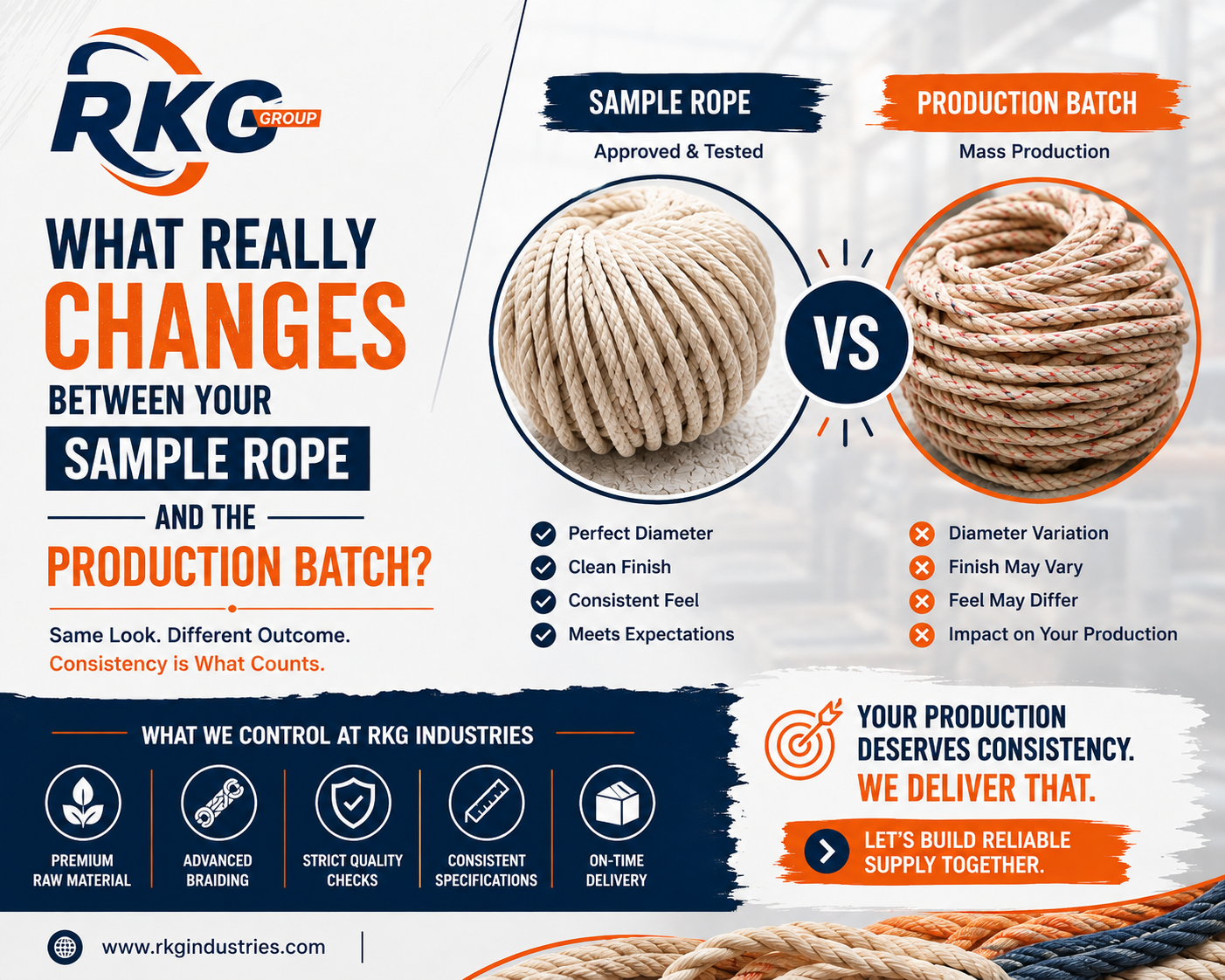
A rope sample can look perfect when it reaches your desk. The diameter appears right. The braid looks clean. The colour matches your requirement. The rope feels flexible enough, and the sample performs well in your initial testing.
Then the bulk order arrives—and something feels different. The rope may be slightly harder or softer, the diameter may not feel exactly the same, the surface finish can vary, or the rope may behave differently during your production process.
This is one of the most important issues buyers should discuss with Rope Manufacturers in India before approving a large order. A sample is not the production batch. It is a reference for what the manufacturer is expected to reproduce at scale.
The real question is: how closely can the approved sample be maintained throughout the production quantity?
Why Can a Sample and Production Batch Feel Different?
Rope manufacturing involves several variables working together. The raw material, yarn characteristics, twisting or braiding conditions, tension, diameter, finishing and production settings can all influence the final rope.
RKG Industries manufactures braided and twisted ropes according to required sizes, materials and customer specifications, with quality checks carried out before delivery.
But for a buyer, the important point is not simply whether a manufacturer can make a sample. It is whether the manufacturer understands which characteristics of that sample must remain consistent when production moves from a small quantity to a commercial batch.
1. The Yarn Can Change the Finished Rope
The rope is only as consistent as the yarn going into it. Even when two yarns appear similar, differences in yarn quality, thickness, strength, twist and overall consistency can influence the finished rope.
This becomes particularly important when a rope is being manufactured repeatedly for the same product. For example, if your finished product requires a specific level of flexibility, a change in the yarn characteristics can alter how the rope bends, handles or holds its shape. That is why serious bulk buyers should discuss the raw material and yarn specification, not only the final rope diameter.
2. Diameter Is More Than a Number
A buyer may approve a sample as a 6 mm rope and assume that every subsequent metre will behave identically. In practice, rope diameter is influenced by construction, yarn, tension and manufacturing conditions.
A small variation may not matter for a general-purpose application. But for a product where the rope passes through a hole, fitting, machine, stitching operation or predefined channel, consistency becomes much more important.
RKG Industries currently lists braided rope in sizes from 1 mm to 24 mm, with material and construction selected according to the intended application.
For bulk orders, the better approach is to define the required specification before production rather than relying only on the appearance of the original sample.
3. Braid Construction Can Affect How the Rope Performs
Two ropes can have the same diameter but behave differently. Why? Because the construction inside the rope matters. The braid structure can influence flexibility, surface appearance, handling and overall feel. Changes in production settings can therefore become noticeable even when the basic material and nominal size remain unchanged.
This is especially important for ropes used in packaging, textile products, handicrafts, agricultural products, commercial goods and industrial applications. RKG Industries manufactures braided rope in cotton and polyester for a range of such applications.
For a production buyer, the question should therefore be: “Can you reproduce the same construction—not simply the same diameter?”
4. Material Selection Can Change the Result
Cotton and polyester do not behave in exactly the same way. Cotton braided rope can provide a softer, more natural feel and flexibility, while polyester offers a smooth synthetic construction suited to various commercial and industrial applications.
So if your sample was developed using a particular material specification, changing the material simply to meet a price target can change the final product.
This is one reason buyers should clearly document:
- Material
- Diameter
- Construction
- Colour
- Finish
- Required quantity
- Intended application
These details give the manufacturer a much clearer production reference.
5. Finishing Can Make a Noticeable Difference
Sometimes the rope is technically within the expected specification but still looks or feels different.The reason can be the finishing. Surface appearance, softness, compactness and handling characteristics can influence how a rope looks when incorporated into the finished product. For applications where appearance matters—such as decorative products, textile goods, packaging or consumer products—finish should be treated as part of the specification rather than an afterthought.
A good sample approval process should therefore record not just what the rope measures, but also how it looks and behaves.
6. Production Quantity Changes the Manufacturing Challenge
Making a few metres for approval is one task. Producing thousands of metres with consistent characteristics is another. During commercial production, maintaining consistency across the entire batch becomes important. This is where manufacturing discipline, machinery settings, raw-material control and inspection procedures matter.
RKG Industries describes its production process as including raw-material selection, processing and manufacturing, twisting and finishing, followed by quality checking before delivery. For buyers, this means the conversation should move beyond: “Can you make this sample?” and toward: “How will you maintain this specification throughout my production batch?”
What Should You Approve Before Placing a Bulk Rope Order?
A sample should become a production reference, not just a physical piece of rope kept in the office.
Before approving the order, confirm the following:
| Parameter | What the Buyer Should Confirm |
| Material | Exact fibre/material required |
| Diameter | Required size and acceptable tolerance |
| Construction | Braided or twisted construction |
| Colour | Exact colour/reference where applicable |
| Finish | Required surface feel and appearance |
| Application | Where and how the rope will be used |
| Quantity | Total commercial requirement |
| Packaging | Roll/coil and packing requirements |
| Consistency | Expected batch-to-batch uniformity |
This becomes especially useful when the same rope will be reordered regularly.
What Should You Ask Rope Manufacturers in India Before Bulk Production?
Instead of asking only for the lowest quotation, ask questions that protect the production requirement.
1. Will the bulk rope follow the approved sample?
Ask how the approved sample will be used as the production reference.
2. Which specifications will be controlled during production?
Diameter, construction, material and finish should be discussed according to the application.
3. Can the rope be manufactured according to my required size and application?
Custom requirements should be discussed before production starts.
4. How is the finished batch checked before dispatch?
A manufacturer’s inspection process can tell you much more than a sales quotation.
5. Can you maintain the same specification for repeat orders?
This is particularly important for manufacturers who use the rope continuously in their own production.
Why RKG Industries Takes the Production Requirement Seriously
RKG Industries manufactures yarn, ropes and textile products, including braided and twisted rope solutions. The company states that it works with cotton, polyester, jute and recycled fibres and provides customized production according to client requirements.
For braided rope specifically, RKG Industries offers cotton and polyester options from 1 mm to 24 mm, with bulk supply and application-based specification discussions. That matters because a commercial rope order should not begin with a generic product description. It should begin with a clear understanding of what your finished product needs the rope to do.
Sample Approval Should Be the Start of the Conversation
A good sample gives you confidence. A well-defined production specification gives you control. When buying rope in bulk, don’t approve a sample based only on appearance. Look at the material, diameter, construction, finish, flexibility and application requirements together.
The objective is simple: the rope you approve should become the standard your manufacturer works toward throughout production.That is the difference between simply buying rope and establishing a dependable manufacturing supply.
Frequently Asked Questions
1. Is a rope sample always identical to the production batch?
Not automatically. A sample is a production reference, while a commercial batch involves much larger quantities and sustained manufacturing. Buyers should clearly define the material, size, construction, finish and other applicable specifications before production.
2. Why can two ropes with the same diameter perform differently?
Diameter alone does not define a rope. Material, yarn characteristics, braid or twist construction, tension and finishing can all influence the final rope’s flexibility, handling and performance.
3. What should I check before approving a rope sample?
Check the material, diameter, construction, colour, surface finish, flexibility and suitability for the intended application. If the rope will be used in a manufacturing process, test it under actual production conditions where possible.
4. Can RKG Industries manufacture braided rope for bulk orders?
Yes. RKG Industries states that it supplies braided rope for bulk and commercial requirements and offers cotton and polyester braided rope in a 1 mm to 24 mm size range.
5. How can I get a more accurate rope quotation from RKG Industries?
Provide the required material, diameter, quantity, application, color or finish requirements and packaging details. These specifications help the manufacturer understand the actual requirement before discussing the suitable rope and quotation.
Need the Same Rope Beyond the Sample?
If you’re sourcing rope for regular production, wholesale, packaging, textile products or another commercial application, don’t send only a sample and ask for a price.
Send the sample details + required material + diameter + quantity + application.
RKG Industries can discuss the suitable rope specification for your requirement and bulk supply needs.
Request your rope requirement today and get a specification-based quotation from RKG Industries.