 info@rkgindustries.com
  +91-7419008652, +91-9355108652
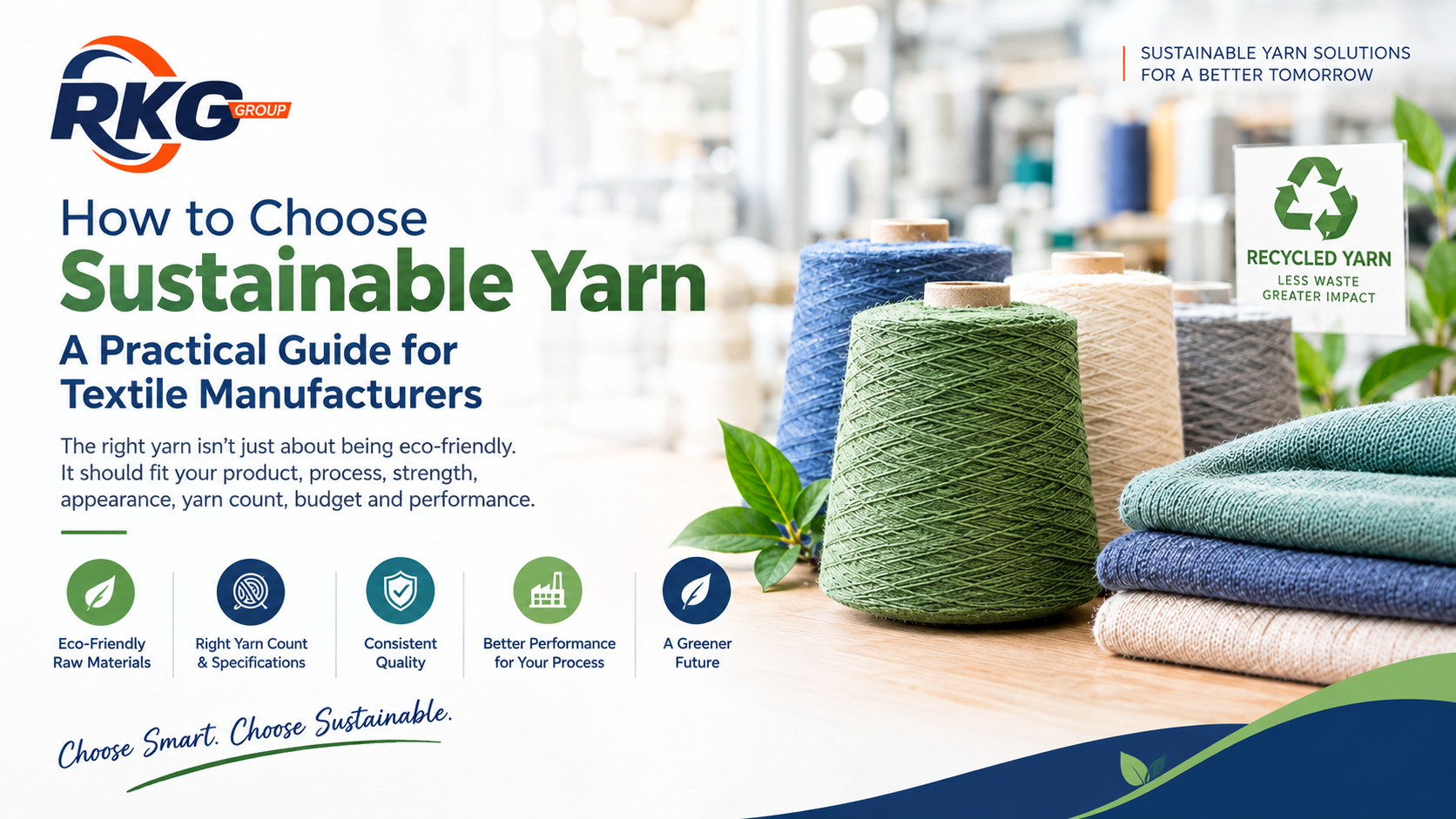
Choosing a sustainable yarn is not simply about picking a yarn labelled “eco-friendly.” The right yarn has to suit the product, manufacturing process, required strength, appearance, yarn count, budget and expected performance.
This becomes even more important when the yarn is being purchased for commercial production. A yarn that works well for a small sample may not necessarily deliver the same results when ordered in larger quantities.
For textile manufacturers, product developers, craft businesses and industrial buyers, the better question is not “Is this yarn sustainable?” It is:
“Is this sustainable yarn suitable for my application and consistent enough for the quantity I need?”
RKG Industries works with recycled yarn and rope solutions, helping buyers evaluate yarn according to its intended application rather than choosing only on the basis of the sustainability claim.
What Makes a Yarn Sustainable?
Sustainable yarn can be produced using recycled, recovered or other more resource-conscious raw materials instead of relying entirely on newly produced fibres.
Recycled yarn, for example, can make use of suitable textile waste and other recovered material that would otherwise have limited value. The exact characteristics of the finished yarn depend on the raw material, processing method, yarn count and intended application.
That is why two yarns described as sustainable can behave quite differently.
For a buyer, sustainability should therefore be considered alongside quality and application suitability.
1. Start With the Finished Product
Before comparing suppliers, define what you are actually making.
The yarn required for a knitted product may have different requirements from yarn being used in weaving, textile accessories, ropes or other industrial products.
Consider:
- What will the finished product be?
- Will the yarn be knitted or woven?
- Does it need a softer hand feel?
- Is strength more important than appearance?
- Will the product undergo repeated handling?
- Does the yarn need to run through a particular machine?
- What level of surface uniformity is required?
These questions narrow down the type of yarn you should request from a sustainable yarn manufacturer in India.
Starting with the application prevents a common purchasing mistake: selecting a yarn first and trying to make the product fit around it.
2. Check the Yarn Count You Actually Need
Yarn count has a direct relationship with the thickness and characteristics of the yarn.
A sustainable yarn supplier may offer different counts depending on the raw material and spinning process. RKG Industries, for example, offers recycled open-end yarn in counts ranging from 2s to 30s.
The correct count depends on your production requirement.
Do not approve a yarn simply because the count matches your existing specification. Also compare its performance, appearance and behaviour during processing.
For bulk buyers, the important question is:
Does the yarn consistently meet the required count throughout the production lot?
3. Look Beyond “Recycled” on the Specification Sheet
The word “recycled” tells you something about the raw material approach, but it does not tell you everything about the yarn.
Before placing an order, ask the supplier about:
- Raw material composition
- Yarn count
- Spinning method
- Expected strength
- Yarn appearance
- Surface characteristics
- Available colours or shades
- Suitable applications
- Packaging and quantity
- Quality-control checks
- Sample-to-bulk consistency
This information gives you a much clearer basis for comparing suppliers than a sustainability statement alone.
4. Test the Yarn for Your Actual Application
A yarn sample should be treated as a production reference, not simply as something to look at.
If you are buying sustainable yarn for manufacturing, test it in the process where it will actually be used.
For example, check:
During knitting:
Does the yarn run smoothly? Is the fabric appearance acceptable? Are there unwanted variations?
During weaving:
Does it maintain the required performance under processing conditions? Does the finished fabric meet your expectations?
For industrial applications:
Does the yarn provide the required combination of strength, handling and durability?
A supplier can provide general specifications, but your own production trial gives you information that a catalogue cannot.
5. Pay Attention to Lot-to-Lot Consistency
This is one of the most important considerations when buying yarn in commercial quantities.
A sample can look excellent. The real test comes when the material is supplied in production quantities.
Differences in raw material and processing can affect:
- Yarn appearance
- Thickness
- Strength
- Texture
- Colour
- Handling
- Machine performance
Before approving a bulk order, ask how the supplier controls consistency between lots.
If your finished product needs a uniform appearance, even relatively small variations can become noticeable after production.
6. Compare Sustainable Yarn on Performance, Not Just Price
Price is obviously important, but the lowest quoted rate is not necessarily the lowest production cost.
Suppose one yarn has a lower purchase price but creates more wastage, requires process adjustments or produces inconsistent output. The initial saving may disappear during manufacturing.
A better comparison includes:
Purchase price + processing performance + wastage + consistency + suitability for the finished product.
For this reason, buyers should request samples from shortlisted sustainable yarn manufacturers in India and compare them using the same production conditions wherever possible.
7. Ask Whether the Yarn Fits Your Existing Production Setup
A sustainable yarn should work within your manufacturing requirements rather than forcing unnecessary changes to your process.
Before ordering, discuss your:
- Machine type
- Product specifications
- Yarn count
- Required quantity
- Expected production volume
- End-use
- Quality requirements
If you already use a particular yarn, provide the existing specification or a reference sample where appropriate. This gives the manufacturer a much clearer understanding of what you are trying to achieve.
Sustainable Yarn Does Not Mean One Yarn Fits Every Product
One of the biggest mistakes buyers make is treating sustainable yarn as a single category.
There are different raw materials, counts, constructions and production methods. The correct choice depends on what you intend to manufacture.
For example, a yarn selected for knitting may not be the first choice for an application where different strength or handling characteristics are required.
This is why product development should begin with the end-use and work backwards to the yarn specification.
Questions to Ask Your Sustainable Yarn Supplier
Before approving a supplier, ask these practical questions:
What raw material is used?
Understand whether the yarn is produced from recycled textile material, recovered fibres or another source.
Which yarn counts are available?
Confirm that the required count can be supplied consistently at your intended quantity.
What applications is the yarn suitable for?
A manufacturer should be able to explain where the yarn is normally used and where it may not be suitable.
Can I test a sample before ordering in bulk?
A production trial can reveal issues that are not obvious from specifications alone.
How is bulk consistency maintained?
Ask how the supplier handles quality checks and production-lot consistency.
Can you supply the quantity I need?
For commercial buyers, production capacity and supply continuity matter just as much as the first sample.
Why Choosing the Right Manufacturer Matters
The yarn itself is only one part of the purchasing decision. The manufacturer you choose can have a direct impact on quality consistency, communication, specification matching and bulk supply.
RKG Industries focuses on recycled yarn and rope solutions for buyers looking for practical material options for textile and industrial applications.
For businesses considering recycled open-end yarn, you can review the dedicated Recycled Open-End Yarn product page to understand the available count range and application direction.
You can also learn more about RKG Industries and its recycled yarn and rope manufacturing approach through the RKG Industries About Us page.
Final Checklist Before You Place the Order
Before approving your next sustainable yarn purchase, check these points:
| What to Check | Why It Matters |
| Raw material | Helps you understand the yarn composition and sourcing |
| Yarn count | Determines whether it matches your product requirement |
| Strength | Important for processing and end-use performance |
| Appearance | Affects the look and consistency of the finished product |
| Application suitability | Ensures the yarn fits your manufacturing process |
| Sample performance | Shows how the yarn behaves in actual production |
| Lot consistency | Reduces unwanted variation in bulk orders |
| Supply capacity | Helps avoid production interruptions |
| Price vs. performance | Gives a more realistic view of total production cost |
Choose Sustainable Yarn With the End Product in Mind
The right sustainable yarn is not necessarily the one with the strongest sustainability claim or the lowest price.
It is the yarn that matches your application, meets your required specifications, performs properly in production and remains consistent when you move from sample quantities to commercial volumes.
If you are sourcing recycled yarn for your next textile or industrial project, RKG Industries can discuss your yarn requirement, count, application and quantity before you make a bulk purchasing decision.
Conclusion
Sustainable yarn selection should start with the finished product, not just the sustainability label.
For commercial buyers, the right yarn needs to meet the required count and performance while remaining suitable for the production process and consistent across larger quantities. Raw material, strength, appearance, machine compatibility, lot consistency and supply capacity all deserve attention before a bulk purchase is approved.
A sample may tell you whether a yarn looks and performs right initially. A proper production trial and supplier evaluation tell you whether it can support your actual manufacturing requirements.
If you are sourcing recycled or sustainable yarn, RKG Industries can help you discuss the required yarn count, application, quantity and performance expectations before moving ahead with a bulk requirement.
Need sustainable yarn for your next project? Contact RKG Industries to discuss your specification and identify a suitable yarn option for your application.
Frequently Asked Questions
1. How do I choose the right sustainable yarn for my product?
Choose sustainable yarn based on your end-use, yarn count, required strength, processing method, appearance, machine compatibility and quantity requirement. A yarn suitable for knitting may not be suitable for weaving or industrial applications. Always test a sample in your actual production process before placing a bulk order.
2. Is recycled yarn suitable for commercial production?
Yes, recycled yarn can be suitable for commercial production when its count, strength, consistency and other specifications match the application. The important point is not simply whether the yarn is recycled, but whether it can perform consistently throughout the required production quantity.
3. What should I check before buying sustainable yarn in bulk?
Before placing a bulk order, check the raw material, yarn count, strength, appearance, application suitability, sample performance, lot-to-lot consistency, quality checks, supply capacity and overall cost. Comparing these factors helps reduce the risk of receiving yarn that performs differently from the approved sample.
4. What yarn count should I choose for recycled open-end yarn?
The required yarn count depends on the finished product and manufacturing process. Recycled open-end yarn is available in different counts, and RKG Industries offers counts ranging from 2s to 30s. Buyers should select the count according to their product specification rather than choosing a count only because it is commonly used.
5. Why is sample testing important before ordering sustainable yarn?
Sample testing shows how the yarn behaves under your actual knitting, weaving or manufacturing conditions. It can reveal differences in running performance, appearance, strength, texture and consistency that may not be apparent from a specification sheet. For commercial buyers, production testing is an important step before approving a bulk order.