 info@rkgindustries.com
 +91-7419008652, +91-9355108652
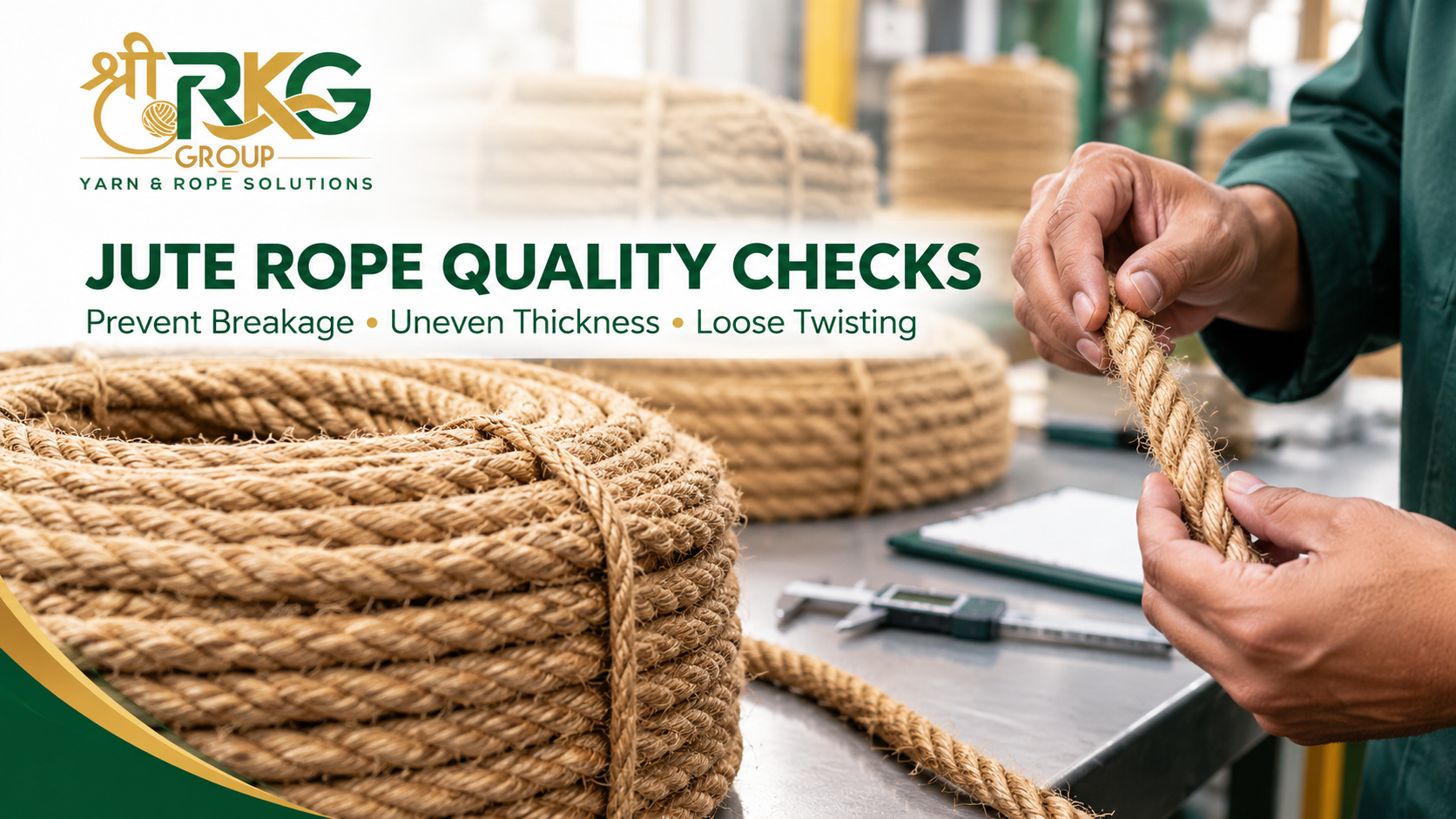
If jute rope breaks during packaging, changes in length or thickness, or becomes loose during handling, it can disrupt the production line. Workers may have to re-tie bundles, slowing down packaging, and manufacturers may face wastage of both material and time. For businesses that use or purchase jute rope in bulk, these are not insignificant issues; they directly impact daily consumption, production time, and the consistency of finished products.
The real problem arises when the rope doesn’t meet the requirements of the intended purpose. Rope used for lightweight packaging has different demands than rope used for furniture, handicrafts, or agricultural purposes. For buyers searching for jute rope manufacturers in India, understanding these practical issues helps establish clear specifications and avoid preventable problems during production and use.
Why Does Jute Rope Break During Tying?
Rope breakage during tying can result from several conditions. The fibre quality, yarn construction, twisting consistency and condition of the rope all influence its performance.
A rope may also fail because it is being used for a load or application beyond its intended capacity.
The Problem with Uneven Fibre and Twisting
Jute rope is made by twisting yarns produced from natural jute fibres. If the yarn contains weak sections or the twisting is inconsistent, the finished rope may have areas that perform differently under tension.
This becomes noticeable when workers pull the rope tightly around a package or repeatedly tighten knots during bundling.
If rope repeatedly breaks during the same operation, record where the break occurs and under what conditions. Check whether the failure happens near a knot, at a sharp edge or along an apparently weak section. Share these observations with the supplier and request an assessment of the rope construction and, where appropriate, tensile-strength test results.
Increasing rope thickness alone may not solve the problem if the underlying issue is inconsistent construction or damage during use.
How Does Inconsistent Rope Thickness Affect Production?
For businesses purchasing jute rope by the coil or bundle, variations in thickness can create problems beyond appearance.
A handicraft manufacturer may struggle to maintain uniform dimensions across finished products. A packaging business may find that one section ties easily while another requires more effort. Automated or semi-automated operations may also experience feeding and handling difficulties when rope dimensions vary beyond the equipment’s tolerance.
Check Diameter at Multiple Points
Measuring only one section of a rope does not establish that the entire supply is consistent.
For incoming material checks, measure several points along representative rope samples using the same method. Record the results and compare them against the agreed specification.
| Quality Check | Practical Method | Problem It Helps Identify |
| Diameter consistency | Measure multiple sections | Uneven thickness |
| Twist consistency | Inspect the rope along its length | Loose or irregular construction |
| Visible fibre condition | Look for damaged or unusually weak sections | Potential defects |
| Knot performance | Test using the intended tying method | Difficulty securing packages |
| Strength requirements | Use an appropriate test method | Whether the rope meets the agreed strength specification |
The acceptable variation should be agreed with the supplier before the order is placed. A visual inspection can identify obvious irregularities, but it cannot replace strength testing when load performance matters.
Why Does Jute Rope Become Loose During Use?
A rope that feels firm on the coil may behave differently when repeatedly handled, bent or tied. Loose twisting, unsuitable construction, abrasion and the way the rope is used can affect its performance. Natural fibres can also respond to changing moisture conditions.
In packaging operations, loose construction may make tying less convenient. In handicraft manufacturing, it can affect the finished product’s appearance and consistency.
Match Rope Construction to the Application
The construction required for decorative wrapping may differ from that needed for repeated manual bundling.
Before approving a bulk order, test a representative sample using the actual tying method, package dimensions and working conditions. Check whether the rope maintains its construction during normal handling and whether knots remain secure for the intended purpose.
If the rope is used in a finished product, evaluate the appearance and handling of the completed item—not just the loose rope.
Jute Rope for Packaging, Agriculture and Manufacturing
Different applications create different demands on rope performance. Treating every jute rope as an interchangeable product can lead to unnecessary material consumption or premature failure.
| Application | Main Requirement | Issue to Watch |
| Packaging and bundling | Convenient tying and secure knots | Breakage during tightening |
| Handicrafts and decorative products | Uniform appearance and texture | Visible thickness variation |
| Furniture and product finishing | Consistent construction | Uneven surface or loose twisting |
| Agricultural tying | Suitable handling for the intended task | Moisture-related deterioration |
| Wholesale distribution | Consistent product specifications | Differences between batches |
Jute absorbs moisture, so prolonged damp exposure can contribute to deterioration. Rope stored in wet conditions or in contact with damp flooring may not perform like properly stored material.
Keep stock dry, allow suitable ventilation and avoid storing coils where water can collect. For outdoor applications involving prolonged wet exposure, assess whether a suitable synthetic rope would provide better service life.
Jute rope should not be used for lifting people, suspended loads or safety-critical work unless the specific product is designed, tested and certified for that purpose.
What Should Bulk Buyers Check When a New Jute Rope Shipment Arrives?
A simple incoming inspection can identify differences before the rope enters production.
Inspect Before Distributing the Stock
Keep a sample from each incoming batch and compare it with the previously approved sample or purchase specification.
Check the following:
- Whether the delivered diameter matches the agreed requirements.
- Whether the twisting and visible fibre condition remain consistent.
- Whether the coils contain the agreed rope length.
- Whether the material shows signs of dampness, damage or contamination.
- Whether the rope performs as expected in the intended application.
If a difference is found, photograph the affected sections, record the batch details and inform the supplier before using the entire shipment.
For repeat purchases, retaining an approved sample and written specification makes it easier to identify whether a later delivery differs from the original requirement.
Jute Rope Manufacturers in India: Discuss Your Requirements with RKG Industries
For a business purchasing rope regularly, the objective is not simply to obtain a coil at the lowest price. The rope must perform consistently in the operation for which it is purchased.
RKG Industries operates in the rope and yarn sector. Businesses considering jute rope should confirm the company’s current product availability, construction options and specifications before placing an order.
When making an enquiry, provide the intended application, required diameter, approximate quantity and any specific performance requirements. If the rope has previously caused problems, explain whether the issue involved breakage, loose twisting, thickness variation or moisture exposure.
These details make the discussion more useful than a quotation request based on diameter and price alone.
Conclusion
Rope breakage, uneven thickness and inconsistent twisting can interrupt packaging, increase material waste and affect finished-product quality. These problems are easier to address when the required construction and performance are defined before bulk purchasing begins.
For businesses searching for jute rope manufacturers in India, the practical priority is to match the rope to its intended use, check incoming material against an agreed specification and investigate recurring failures instead of relying on thickness alone.
Need rope for a commercial or industrial application? Contact RKG Industries to discuss your rope requirements and confirm whether a suitable product is available.
Frequently Asked Questions
1. Why does jute rope break even when it looks thick?
Thickness alone does not establish rope strength. Fibre condition, construction, twisting, damage and the load applied can all affect performance. Appropriate strength testing is necessary where performance requirements are critical.
2. How can I check whether jute rope thickness is consistent?
Measure multiple sections of representative samples using a consistent method. Compare the results against the diameter and tolerance agreed with the supplier.
3. Does moisture affect jute rope?
Yes. Jute absorbs moisture, and prolonged damp conditions can contribute to deterioration. Store coils in a dry, ventilated area and inspect material that has become wet.
4. What information should I provide when requesting a bulk quotation?
Specify the intended application, rope diameter, construction requirements, quantity, coil length, packaging format and delivery location. Include any testing or dimensional tolerances required for your operation.
5. Can jute rope be used for heavy loads?
Suitability depends on the specific rope’s verified capacity and the application. Do not assume that a thick jute rope is suitable for lifting or securing heavy loads without appropriate test data and confirmation from the manufacturer.