 info@rkgindustries.com
  +91-7419008652, +91-9355108652
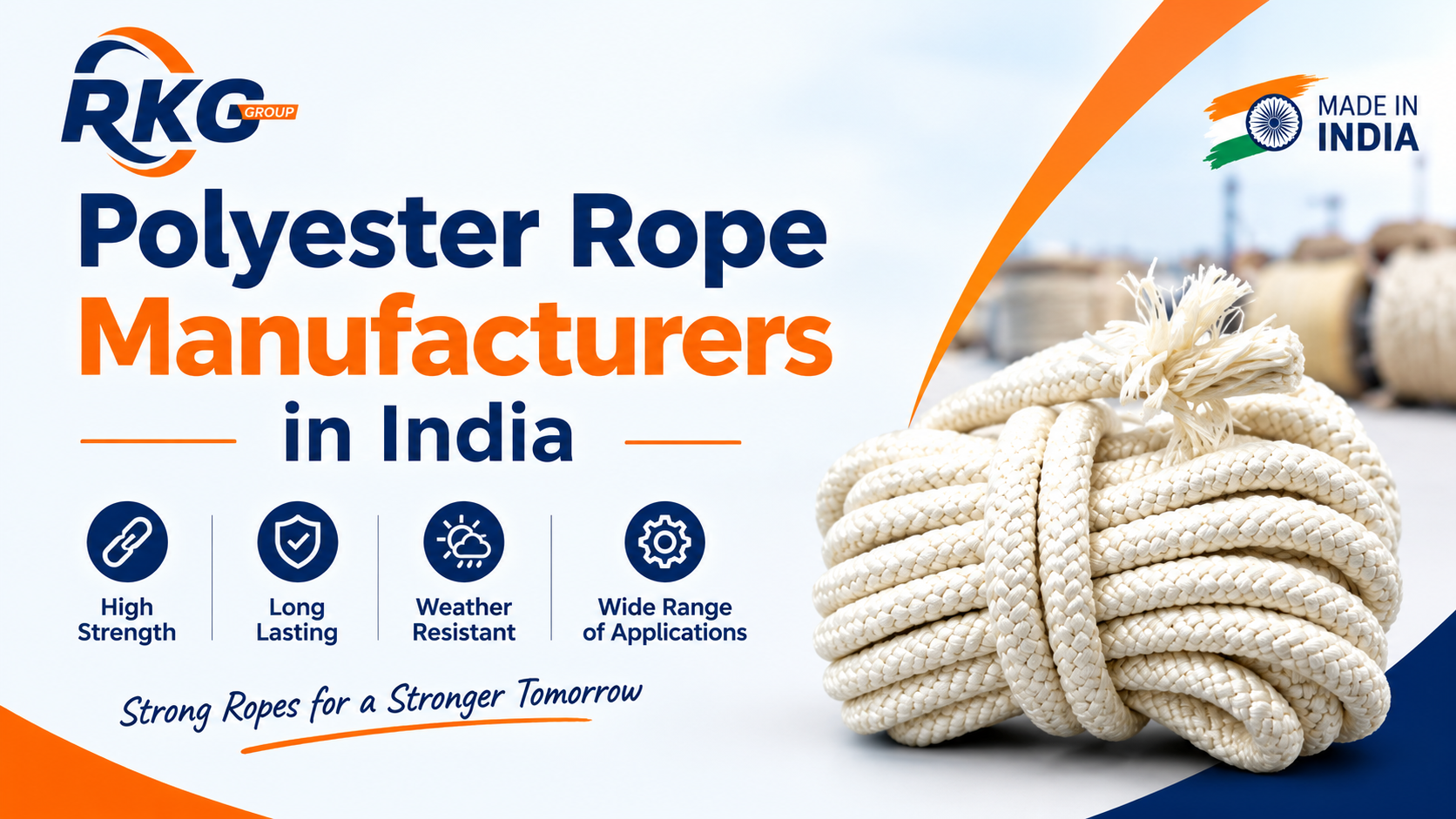
If you are searching for polyester rope manufacturers in India, chances are you already know what a bad rope costs. A lifting sling that stretches more than expected, a marine mooring line that chafes through in one monsoon, a pallet of rope delivered in a diameter that does not match the quote. Each one costs more than the rope itself.
This blog is written for buyers: purchase managers, boat owners, fabricators, agricultural suppliers, event and rigging contractors, and traders who resell rope. It explains what polyester rope is, where it beats other fibres, how it is made, what to ask a supplier, and what actually moves the price. It is based on how rope is spun, twisted, braided and tested in practice.
What Should You Look for in a Polyester Rope Manufacturer in India?
A reliable manufacturer should be able to tell you, in writing: the yarn grade used, the rope construction, the exact diameter and weight per 100 metres, the minimum breaking strength, and the batch it came from. They should also be ready to send a sample and to accept your own third-party testing. If a supplier only quotes a price per kg and cannot answer these points.
What Is Polyester Rope?
Polyester rope is made from polyethylene terephthalate (PET) yarn, the same family of polymer used in many technical textiles. The filaments are drawn to align the molecules, which gives the yarn high tenacity, and the yarn is then twisted or braided into rope.
Its reputation in the trade comes from a simple combination of traits:
- Low stretch. Polyester elongates far less than nylon under load, so it holds tension and position well.
- Strong UV resistance. It keeps most of its strength after long outdoor exposure, which is why it is a favourite for sun-baked jobs across India.
- Very low water absorption. It does not swell or lose meaningful strength when wet, and it dries quickly.
- Good abrasion resistance. It copes with chafing over pulleys, bollards and rough surfaces better than polypropylene.
- Resistance to many chemicals and rot. It does not rot like natural fibre and handles mild acids and many solvents.
- High melting point. PET melts at roughly 250 degrees Celsius, well above polypropylene or polyethylene.
If you need a floating line, polypropylene is the right choice, and a good manufacturer will tell you that instead of selling you the wrong rope.
Polyester Rope vs Other Ropes: Which One Do You Actually Need?
| Property | Polyester | Nylon | Polypropylene | Manila / Natural fibre |
| Stretch under load | Low | High | Moderate | Low |
| UV resistance | Very good | Moderate | Fair (needs stabiliser) | Poor over time |
| Wet strength | Almost unchanged | Drops noticeably | Unchanged | Drops, rots |
| Floats on water | No | No | Yes | No |
| Abrasion resistance | Very good | Very good | Fair | Fair |
| Best for | Mooring, rigging, lifting, outdoor | Shock loads, towing, anchoring | Floating lines, general use | Decorative, traditional use |
The practical rule: choose polyester when you need strength with minimal stretch and long outdoor life. Choose nylon when the line must absorb shock. Choose polypropylene when it must float or when budget is the main driver.
Types of Polyester Rope Made by Indian Manufacturers
The construction of the rope matters as much as the fibre. Here are the common types you will find when dealing with rope manufacturers in India.
1. Twisted Polyester Rope (3-Strand)
Three strands twisted together. It is the most economical construction, easy to splice, and widely used for general-purpose work, agriculture, packaging and utility lines. It is a little rougher on the hands than braided rope.
2. Braided Polyester Rope
Strands are interlaced instead of twisted, which gives a rounder, smoother and more balanced rope that does not kink or untwist.
3. Hollow Braided and Solid Braided
Hollow braid is soft and flexible, suited to light-duty ties, sports and handling. Solid braid is dense and firm, preferred for flag halyards, sailing sheets and decorative-yet-functional uses.
4. 8-Strand and 12-Strand Plaited Rope
These are used for heavy mooring, tug and industrial work. They are torque-balanced, resist hockling, and are easier on winches.
5. Double Braid Polyester Rope
A braided core inside a braided cover. The core carries most of the load while the cover protects it from abrasion. It is a common pick for yacht running rigging and for lines that see constant handling.
6. Polyester Yarn and Twine
Many buyers also need the raw material. Rope and yarn manufacturers often supply polyester twine, sewing and binding yarn, and multifilament yarn for netting and industrial stitching. If your process uses both rope and yarn, buying from one source keeps your quality and colour matching consistent.
Where Is Polyester Rope Used? Real Applications in India
- Marine and fishing: mooring lines, anchor warps, dock lines and net ropes, especially on the coasts of Gujarat, Maharashtra, Tamil Nadu and Kerala where salt, sun and humidity are punishing.
- Construction and scaffolding: tie-downs, hoisting lines for light loads and barricade work.
- Logistics and transport: truck load securing, tarpaulin lashing and cargo binding.
- Agriculture and horticulture: greenhouse support, trellis lines, animal handling and bundling.
- Sports and fitness: tug of war, battle ropes, climbing frames, gym and school equipment.
- Events and decoration: stanchion ropes, stage rigging support, tents and shamiyana work.
- Industrial packaging: bundling and strapping where low stretch keeps loads tight.
How Polyester Rope Is Made: What Quality Looks Like at Each Stage
Understanding the process helps you ask sharper questions.
Step 1: Yarn Selection
The yarn grade sets the ceiling for strength. High-tenacity filament yarn gives a stronger rope than spun or low-grade yarn of the same diameter. Ask which yarn is used and whether it is virgin or reprocessed.
Step 2: Twisting and Plying
Yarns are twisted into strands and strands are laid or braided. Twist angle controls flexibility, strength and how well the rope holds together under load. Uneven twist is visible as a rope that spirals or looks lumpy.
Step 3: Closing or Braiding
In twisted rope the strands are closed under controlled tension. In braided rope the carriers interlace at a fixed pick count. Consistent tension is what keeps the diameter uniform across the full coil.
Step 4: Heat Setting and Finishing
Heat setting stabilises the rope so it does not shrink or change length in use. Coatings, UV stabilisers and colour finishes are added at this stage when needed.
Step 5: Testing and Packing
A responsible manufacturer checks diameter, linear density and breaking load on samples from each batch, then packs coils or reels with clear labels. For rope sold against recognised standards such as ISO 1141 for polyester rope, ask for the test basis in writing.
Questions to Ask Before You Order from Any Rope Manufacturer
- What is the minimum breaking strength for this diameter and construction? Get a figure, not an adjective.
- What is the weight per 100 metres? Weight reveals how much material is really in the rope. A rope that is light for its size is usually under-filled.
- Is the yarn virgin high-tenacity polyester?
- Can you send a sample before bulk dispatch? Test it, measure it, then decide.
- What diameter tolerance do you hold? A rope sold as 12 mm that measures 10.5 mm will not fit your hardware.
- Can you produce my specification? Custom length, colour, tracer thread, sealed ends, eye splices or thimbles should be possible.
- What is your lead time for regular and repeat orders?
- How do you pack for transport and export? Moisture-sealed coils and reels prevent damage in transit.
- Will you share references or a previous customer type in my industry?
Common Mistakes Buyers Make
- Choosing by diameter only and ignoring construction and strength.
- Using polyester where a floating line was needed.
- Skipping a sample and discovering a problem after 2,000 metres arrive.
- Ignoring UV and chemical exposure when specifying outdoor jobs.
- Treating all rope manufacturers as interchangeable and picking the lowest quote.
- Reusing a rope that has glazed, flattened, cut strands or heavy chafe damage.
Why Buyers Choose RKG Industries
At RKG Industries, we work as a rope manufacturer and supplier that treats the rope as an engineered product, not a commodity. We talk to you about the job first: the load, the environment, the hardware, the length of service you expect. Then we recommend the construction and diameter that suits it, instead of pushing whatever is on the shelf.
- Specification-led quoting. You receive diameter, construction, weight and strength details with the price.
- Rope and yarn under one roof. Useful if you need polyester rope along with twine or yarn for your own production.
- Samples and clear communication. See and test the rope before you commit.
- Custom orders. Lengths, colours, finishes and end treatments made to your requirement.
- Repeat-order consistency. The rope you reorder should match the rope you approved.
Whether you are a first-time buyer or a distributor stocking regularly, a short conversation about your application usually saves weeks of trial and error.
Conclusion
Choosing among polyester rope manufacturers in India is easier when you stop comparing prices and start comparing specifications. Know the construction you need, ask for weight and breaking strength, test a sample, and pick a supplier who answers your technical questions without hesitation. A rope that is matched properly to its job lasts longer, performs safely and costs less over its life.
If you want a rope made for your exact use, the team at RKG Industries is ready to help you choose the right type, size and finish.
Frequently Asked Questions
1. Which is the best polyester rope manufacturer in India?
There is no single answer for every buyer. The best manufacturer for you is the one that can document yarn grade, diameter, weight and breaking strength, supply a sample, hold tolerance batch after batch, and understands your application. Compare two or three suppliers on these points rather than on price alone.
2. Is polyester rope better than nylon rope?
It depends on the job. Polyester stretches less, resists UV better and loses almost no strength when wet, so it suits mooring, rigging and long outdoor use. Nylon stretches more and absorbs shock, so it suits towing and anchoring where a sudden jerk must be cushioned.
3. Does polyester rope float?
No. Polyester has a density higher than water and sinks. For a floating line, polypropylene is the usual choice.
4. Is polyester rope good for outdoor and marine use?
Yes. It resists sunlight, saltwater, mildew and rot well, which is why it is widely used on boats, jetties and fishing operations.
5. What is the difference between twisted and braided polyester rope?
Twisted rope has three strands laid together. It is economical and easy to splice. Braided rope has interlaced strands, giving a smoother, rounder rope that resists kinking and usually handles better on winches and in the hand.
Get a Quote for Polyester Rope Today
Looking for a dependable rope manufacturer in India? Tell us your application, diameter, length and quantity, and we will recommend the right polyester rope with full specifications and a clear quotation.