 info@rkgindustries.com
  +91-7419008652, +91-9355108652
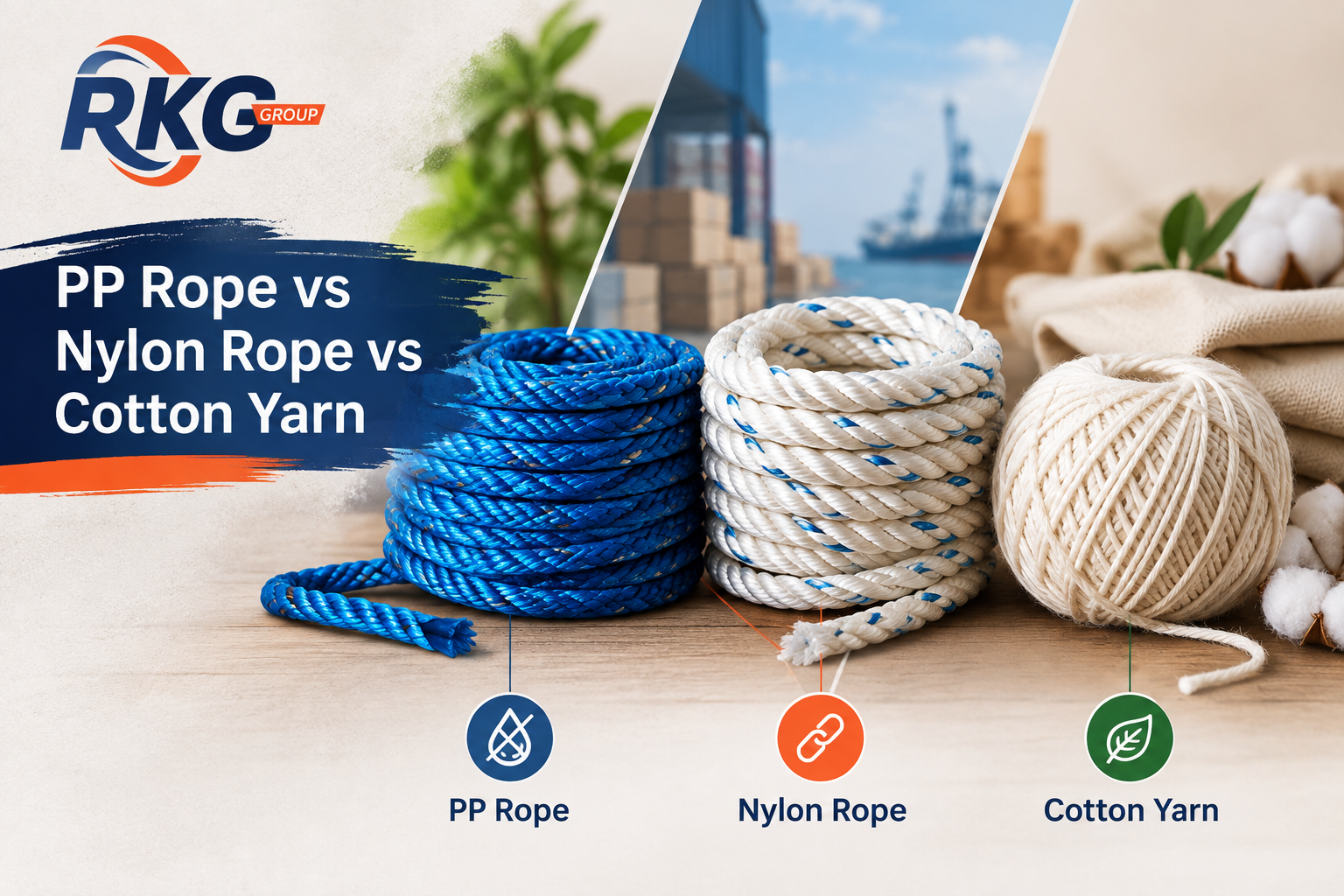
When you are buying rope or yarn for regular production, packaging, tying, handling, or industrial work, the material matters more than it may seem. Polyester rope, nylon rope, and cotton yarn can all look suitable at first, but they behave quite differently once they are actually used.
The common question is: Which one should I buy?
There is no single answer. A rope that works well for lightweight bundling may not be suitable for a job where the rope is under constant tension. Similarly, cotton yarn may be the right option for a textile or decorative requirement but a poor choice for an application that regularly gets exposed to water.
Here is how the three compare when you look at the things that actually matter during use.
PP Rope: A Practical Choice for Lightweight and General-Purpose Work
PP rope means polypropylene rope. It is made from polypropylene, a synthetic material that is widely used for ropes because it is lightweight and does not readily absorb water.
That low weight can make a noticeable difference when the rope is being handled repeatedly. If workers are tying bundles, securing materials, or moving rope around throughout the day, a lighter rope is generally easier to work with.
PP rope is also commonly considered where the rope may come into contact with moisture. Unlike cotton, it does not soak up water in the same way.
For many general-purpose jobs, PP rope offers a useful balance between cost, weight, and everyday usability.
It can be used for applications such as:
- Bundling and tying
- Packaging work
- Agricultural use
- General industrial requirements
- Outdoor utility work
- Material handling
- Temporary securing and tying applications
One thing to keep in mind is that PP rope should not be selected simply because it is inexpensive. If the application involves a high load, continuous friction, or a demanding working environment, the required rope strength and construction should be checked first.
Nylon Rope: When Strength and Flexibility Matter More
Nylon rope is generally considered when the job demands more from the rope.
Compared with PP rope, nylon offers higher strength and good flexibility. It also handles repeated rubbing and movement well, which is important in applications where the rope is not simply tied once and left alone.
Another characteristic of nylon is its stretch. When a load is applied, nylon can elongate rather than remaining completely rigid. In some applications, that flexibility is useful. In others, especially where you need the rope to maintain a fixed length with very little movement, it may not be desirable.
Nylon can therefore make more sense for applications involving:
- Higher loads
- Frequent handling
- Repeated movement
- Abrasion
- Industrial use
- Heavy-duty tying
- Applications where flexibility is important
There is a trade-off, though. Nylon can absorb moisture. So if your main concern is keeping water absorption low, PP rope may be worth considering instead.
The actual rope diameter and construction also matter. Two ropes made from nylon can perform differently depending on how they are manufactured.
Cotton Yarn Is a Different Kind of Material
Cotton yarn should not really be viewed as a direct substitute for every rope application.
Its main advantage is its natural fibre, along with its soft feel and appearance. That makes it useful in areas where the material itself is part of the product’s look or handling experience.
Cotton yarn is commonly considered for textile-related work, handicrafts, decorative products, stitching, tying, and applications where a natural material is preferred.
For example, if you are making a product where a synthetic plastic-like appearance would look out of place, cotton may be the obvious choice.
But cotton has a limitation that needs to be considered before buying it for an outdoor or damp application: it absorbs moisture.
If the yarn is going to remain exposed to water or humidity for long periods, you need to consider whether cotton is suitable for the conditions in which the finished product will actually be used.
So, Which Material Should You Pick?
Instead of comparing the materials only by price, start with the actual job.
If the rope needs to be lightweight and reasonably economical for general tying or bundling, PP rope is often a practical option.
If the rope needs higher strength, flexibility, and resistance to repeated wear, nylon deserves consideration.
If you need a natural fibre with a softer feel or a particular appearance, cotton yarn may be more appropriate.
The table below gives a quick starting point:
| Requirement | PP Rope | Nylon Rope | Cotton Yarn |
| Lightweight handling | Excellent | Good | Good |
| Water exposure | Suitable | Needs consideration | Less suitable |
| High strength requirement | Good | Excellent | Limited compared with synthetic ropes |
| Flexibility | Good | Excellent | Good |
| Repeated abrasion | Good | Excellent | Moderate |
| Natural appearance | No | No | Yes |
| General-purpose tying | Suitable | Suitable | Application dependent |
| Textile/decorative use | Limited | Limited | Very suitable |
This is only a starting comparison. The right product still depends on the exact size, construction, load, and working conditions.
What About Outdoor Use?
This is where buyers often compare PP and nylon.
For an application where the rope will regularly encounter moisture and weight is an important consideration, PP rope can be a sensible option.
Nylon becomes more interesting when the rope needs to handle higher mechanical stress, repeated movement, or abrasion.
But outdoor use is not just about rain. Think about how much sunlight the rope receives, whether it rubs against another surface, how often it is used, and what kind of load it has to handle.
A supplier should know these details before recommending a particular rope.
Don’t Choose Rope Only by Diameter
A common mistake is saying, “I need a 10 mm rope,” and assuming that diameter alone tells you whether the product is suitable.
It doesn’t.
Two ropes with a similar diameter can have different performance because of the material, construction, manufacturing process, and rope structure.
Before purchasing, it is better to tell the supplier:
- Where the rope will be used
- What load it needs to handle
- Whether it will be used indoors or outdoors
- Whether it will contact water
- How frequently it will be handled
- Whether flexibility or low stretch is important
- Required length and quantity
This gives the manufacturer enough information to suggest a product that actually fits the job.
PP Rope vs. Nylon Rope vs. Cotton Yarn: The Simple Answer
There is no need to make the decision complicated.
PP rope is worth considering when you want a lightweight synthetic rope that handles moisture well and works for many general-purpose requirements.
Nylon rope is more suitable to investigate when strength, flexibility, and resistance to repeated wear are important parts of the job.
Cotton yarn is the natural-fibre option when softness, appearance, and the characteristics of cotton are more important than water resistance or heavy-duty rope performance.
The cheapest material is not always the cheapest solution if it needs to be replaced frequently or does not perform properly in the application.
Need Help Choosing the Right Rope or Yarn?
At RKG Industries, buyers can discuss their actual application instead of selecting a material based only on a product name or price.
Whether you are looking for PP rope, nylon rope, or cotton yarn, share your required size, quantity, application, and working conditions with the team. These details make it easier to identify the right material for your requirement before you place a bulk order.
Contact RKG Industries to discuss your rope or yarn requirement.
Frequently Asked Questions
1. Is PP rope better than nylon rope for outdoor use?
PP rope can be a practical choice for outdoor applications where low weight and resistance to water absorption are important. Nylon is generally considered when the application also requires higher strength, flexibility, or better resistance to repeated abrasion. The better option depends on the actual load and working conditions.
2. Which is stronger: PP rope or nylon rope?
Nylon rope generally provides higher strength than PP rope of comparable construction. If the rope will carry substantial loads or experience repeated mechanical stress, strength and working-load requirements should be checked before selecting the rope rather than choosing solely by diameter.
3. Can cotton yarn be used instead of PP rope for tying and bundling?
It can be used for certain lightweight tying or bundling applications, particularly where a natural fibre is preferred. However, cotton absorbs moisture, so PP rope is generally more suitable when the bundled material may be exposed to rain, damp storage, or wet conditions.
4. How do I decide between PP rope and nylon rope for an industrial application?
Start with four details: required load, exposure to water, amount of abrasion, and frequency of use. PP rope is useful where lightweight handling and low water absorption are priorities, while nylon is worth considering where higher strength, flexibility, and repeated wear are involved.
5. What information should I give RKG Industries before ordering PP rope, nylon rope, or cotton yarn?
Tell RKG Industries the application, required diameter or size, approximate load, indoor or outdoor use, moisture exposure, required quantity, and preferred construction. Providing these details helps identify a suitable material instead of selecting a rope or yarn based only on price or appearance.