 info@rkgindustries.com
  +91-7419008652, +91-9355108652
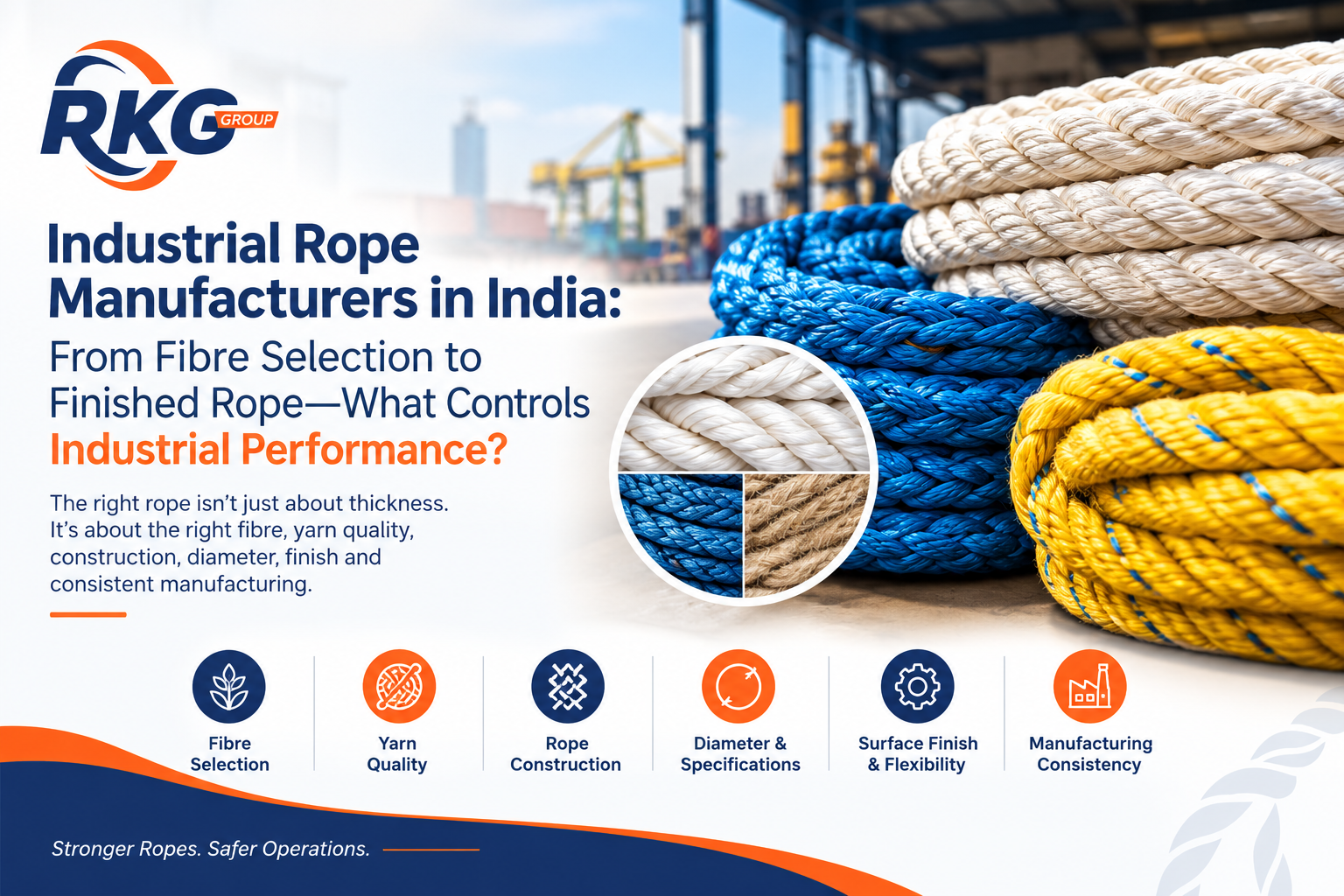
An industrial rope is rarely chosen simply because it looks thick, strong, or durable. In actual production and handling environments, rope performance depends on a combination of factors: fibre selection, yarn characteristics, rope construction, diameter, braiding or twisting, surface finish, and manufacturing consistency. A rope that works well for one application may not deliver the same performance in another.
This is why working with experienced Industrial Rope Manufacturers in India matters when rope is being purchased for regular industrial use rather than occasional handling. For manufacturers and bulk buyers, the important question is not only “How strong is the rope?” It is whether the finished rope is suited to the load, handling method, environment, and frequency of use.
Fibre Selection Is the First Performance Decision
The raw material establishes the basic characteristics that a finished rope can deliver. Industrial ropes may be produced using materials such as cotton, polyester, polypropylene, nylon, jute, or recycled fibres, depending on the required application.
Each fibre behaves differently. Polyester, for example, is commonly selected where strength, dimensional stability, and resistance to regular use are important. Polypropylene offers a lightweight option for applications where low density and practical handling are required. Nylon is known for its strength and elasticity, while cotton may be preferred where a softer feel and natural fibre characteristics are required.
Therefore, selecting the fibre should begin with the application rather than the rope’s appearance. A manufacturer needs to understand where the rope will be used, what type of load it will experience, how frequently it will be handled, and what environmental conditions it will encounter.
Yarn Quality Influences the Finished Rope
The next stage is yarn. Even when the correct fibre has been selected, variations in yarn quality can influence the finished rope’s consistency. Yarn count, uniformity, twist, strength, and surface characteristics all contribute to how the material behaves during rope manufacturing. For industrial buyers, this becomes particularly important in bulk production.
A rope supplied repeatedly to a factory should maintain reasonably consistent characteristics from batch to batch. Significant variation in yarn input can eventually appear as differences in rope diameter, firmness, surface appearance, flexibility, or handling behaviour. This is one reason manufacturers with controlled production processes are important for recurring industrial requirements.
Rope Construction Changes How the Product Behaves
Fibre alone does not define an industrial rope. The same basic material can be converted into ropes with different constructions, including braided and twisted structures. Construction affects flexibility, handling, surface characteristics, compactness, and how the rope responds during use.
Braided Rope
Braided construction creates interlaced strands that form the rope body. Depending on the design, braided ropes can offer a relatively smooth and uniform surface and can be produced in different diameters and constructions.
They may be used across packaging, textile, agricultural, industrial, marine-related, and general handling applications, depending on the material and specification.
Twisted Rope
Twisted rope is produced by twisting yarns or strands together to create the finished structure. Its characteristics can differ from braided rope in terms of handling, flexibility, construction, and application suitability.
Neither construction should automatically be considered suitable for every industrial requirement. The application determines what construction makes sense.
Diameter Is a Specification—Not the Complete Performance Story
A common purchasing mistake is to compare industrial ropes primarily by diameter. A larger diameter does not automatically mean a rope is the correct choice for a particular application.
Two ropes with similar dimensions can behave differently because their material, yarn construction, rope structure, density, and manufacturing process are different. For this reason, industrial buyers should consider the complete specification rather than treating diameter as the primary indicator of performance.
Depending on the application, useful specifications may include:
- Material or fibre composition
- Rope construction
- Finished diameter
- Weight or density
- Length supplied
- Colour and finish
- Required flexibility
- Surface characteristics
- Packaging format
- Application-specific performance requirements
Manufacturing Consistency Matters in Bulk Orders
A sample can provide a useful first assessment, but industrial procurement does not end with sample approval. The real test is whether the manufacturer can reproduce the required specification across the production batch.
During manufacturing, factors such as tension, twisting or braiding conditions, yarn feeding, strand formation, diameter control, and finishing can influence the final rope. For a buyer placing recurring orders, consistency becomes a commercial issue as much as a technical one.
A rope that varies noticeably between batches can create problems with assembly, cutting, packaging, machine handling, or product appearance.
This is why established Industrial Rope Manufacturers in India should be evaluated not only on their product catalogue but also on their ability to understand specifications and maintain production consistency.
The Finished Rope Must Match the Actual Working Environment
Industrial rope does not operate in isolation. Its performance depends on how it is used.
A rope intended for bundling and packaging may have very different requirements from rope used for industrial handling, textile applications, agriculture, construction-related work, or repeated manual operations.
Consider four basic conditions:
1. Load
What force will the rope experience?
2. Friction
Will it repeatedly move across another surface?
3. Flexing
Will it be bent, folded, or repeatedly handled?
4. Environment
Will it be exposed to moisture, sunlight, chemicals, dust, heat, or outdoor conditions?
These factors should be discussed with the manufacturer before finalizing the specification.
What Should Industrial Buyers Discuss With the Manufacturer?
Instead of sending only a diameter requirement, buyers can provide a more complete application brief.
A useful enquiry should mention:
- Intended application
- Required rope material
- Preferred braided or twisted construction
- Approximate diameter
- Required length or packaging
- Expected quantity
- Operating environment
- Flexibility or handling requirements
- Colour or finish requirements
- Whether the requirement is one-time or recurring
This gives the manufacturer enough information to determine whether the proposed rope specification is appropriate.
RKG Industries: Industrial Rope Manufacturing With Application in Mind
RKG Industries manufactures industrial ropes with a focus on material selection, rope construction, dimensional requirements, and application-specific production.
Its industrial rope range includes braided and twisted rope constructions, allowing buyers to specify the structure according to their intended use.
For bulk requirements, the objective is not simply to supply rope by diameter. The specification needs to be understood before production so that the finished product is aligned with the buyer’s operational requirement.
Whether the requirement is for packaging, agriculture, textile applications, industrial handling, construction-related use, or other commercial applications, the correct rope specification starts with understanding how the rope will actually be used.
Conclusion
The performance of an industrial rope is established long before the finished coil reaches the buyer. It begins with fibre selection, continues through yarn preparation and rope construction, and depends on manufacturing controls that determine the consistency of the finished product.
For industrial buyers, the right approach is therefore to evaluate the complete specification—not just diameter, appearance, or price.Choosing capable Industrial Rope Manufacturers in India means finding a manufacturer that can translate your application requirements into a practical rope specification and reproduce that specification consistently in production.
Frequently Asked Questions
1. What materials are commonly used for industrial ropes?
Industrial ropes can be manufactured from polyester, polypropylene, nylon, cotton, jute, recycled fibres, and other materials depending on the required application and performance characteristics.
2. What is the difference between braided and twisted industrial rope?
Braided and twisted ropes use different construction methods, which influence their flexibility, surface characteristics, handling, and application suitability. The appropriate construction depends on the intended use.
3. Does a larger rope diameter always mean better performance?
No. The diameter has only one specification. Material, construction, yarn characteristics, manufacturing quality, and application conditions also influence rope performance.
4. What information should I provide when requesting an industrial rope quotation?
Provide the intended application, material preference, construction, diameter, quantity, length, packaging requirements, operating conditions, and any specific performance or finish requirements.
5. Why is batch consistency important for industrial rope?
Consistent production helps ensure that repeated orders maintain comparable dimensions, construction, handling characteristics, and overall product behaviour, which is particularly important for regular industrial procurement.