 info@rkgindustries.com
  +91-7419008652, +91-9355108652
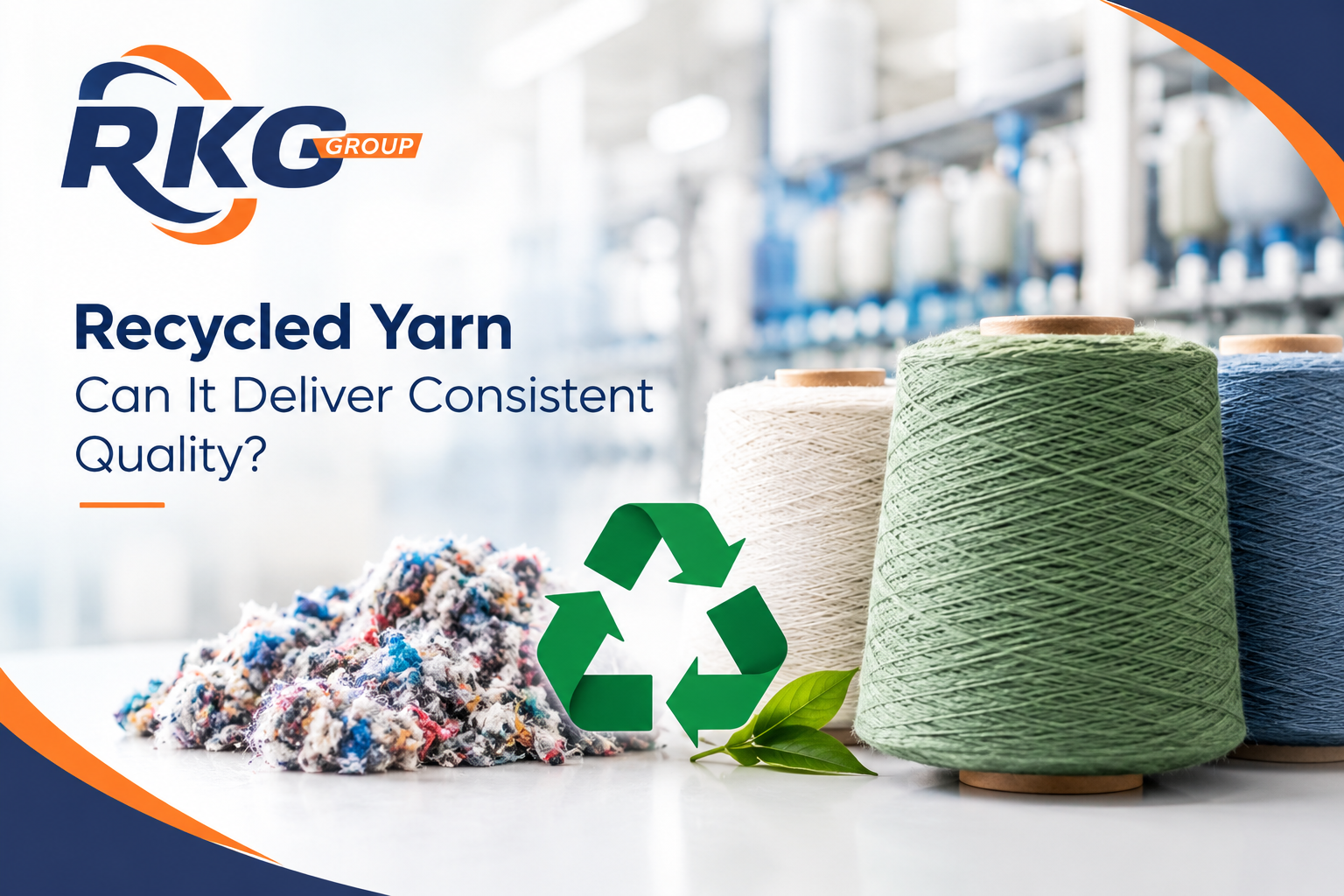
When recycled yarn is recycled, it may look perfect, its color, count, and feel may even perform well in testing, but the true identity of recycled yarn is revealed when orders are placed in bulk.
For manufacturers using yarn in rope, webbing tape, woven products, knitted fabrics, or other textile applications, consistency matters more than just a good-looking sample. Even the slightest change in yarn quality impacts production speed, appearance, and durability.
Therefore, choosing a yarn manufacturer in India requires more than simply comparing prices or selecting recycled material based solely on its sustainability claims. The yarn must also match the technical and production requirements of the application.
What Does Yarn Consistency Actually Mean?
Yarn consistency means that the material supplied across different lots remains sufficiently close to the approved specification and performs predictably in the intended process.
For a buyer, this may include:
- Yarn count: Whether the supplied yarn remains within the agreed count range.
- Strength: Whether the yarn provides the required resistance during processing and use.
- Evenness: Whether thickness and structure remain sufficiently uniform.
- Surface characteristics: Whether the yarn has a suitable finish, feel and appearance.
- Colour consistency: Whether different lots maintain the required shade.
- Processing behaviour: Whether the yarn runs through the buyer’s machinery or production process without unexpected changes.
The exact importance of each factor depends on the end product. A yarn used for a decorative article may have different priorities from one used in industrial rope or webbing.
A consistent yarn is not necessarily the yarn with the highest specification. It is the yarn that repeatedly meets the specification your production actually needs.
Why Recycled Yarn Requires Application-Based Evaluation
Recycled yarn is produced from recovered textile or other suitable waste materials rather than relying entirely on virgin raw material. It can help manufacturers reduce dependence on virgin fibres and incorporate recycled content into their products.
However, “recycled” does not describe one uniform yarn quality.
Different recycled yarns can vary according to:
- The type and quality of recovered material
- Fibre preparation and processing
- Spinning method
- Yarn count
- Blending requirements
- Intended application
- Quality-control procedures
For this reason, buyers should not assume that every recycled yarn will perform identically. A yarn suitable for one application may not be the right choice for another.
For example, a manufacturer producing cotton webbing tape may need to focus on yarn strength, surface consistency and processing behaviour. A buyer using yarn for knitting may place greater emphasis on count, evenness and the way the yarn runs through the machine.
The relevant question is not simply “Is this recycled yarn?” It is:
“Does this recycled yarn provide the consistency required for my finished product?”
The Same Yarn Count Does Not Guarantee the Same Production Result
Yarn count is an important specification, but it is not the complete picture.
Two yarns may be offered at the same count and still behave differently during production. Differences in raw material, construction, strength, evenness or finish can affect how the yarn performs.
This becomes particularly important when a buyer changes suppliers. A replacement yarn may appear similar on paper but produce a different result in the finished product.
For example, a rope manufacturer may notice changes in:
- Rope firmness
- Surface appearance
- Braid formation
- Handling during production
- Finished diameter
- Strength performance
Similarly, a webbing manufacturer may notice differences in the feel, appearance or processing behaviour of the tape.
Count should be treated as a starting specification—not the only basis for approving a yarn.
What Should Buyers Confirm Before Approving Recycled Yarn?
Before placing a larger order, buyers should establish which characteristics must remain consistent from sample to production.
1. Confirm the Exact Yarn Specification
The approved sample should be linked to a clear specification. This may include yarn count, material composition, colour, required strength, application and any other agreed characteristics.
A physical sample alone may not communicate every requirement clearly.
2. Explain the End Application
A yarn manufacturer needs to understand where the yarn will be used. Recycled yarn intended for rope manufacturing may have different requirements from yarn intended for knitting, weaving or decorative products.
Sharing the actual application helps the manufacturer recommend a suitable specification rather than treating every order as interchangeable.
3. Ask How Production Consistency Is Maintained
Buyers should ask how the manufacturer manages consistency between production lots. Relevant questions may include:
- How is the raw material selected?
- How is the yarn count maintained?
- What quality checks are carried out?
- How are production variations identified?
- Can the manufacturer reproduce the approved sample at the required quantity?
The purpose is not to collect a long checklist. It is to understand whether the supplier can repeatedly produce yarn that matches the agreed requirements.
4. Compare the Sample with the Intended Production Conditions
A sample may perform well in a short trial but behave differently during extended production. Where possible, buyers should test the yarn under conditions similar to actual manufacturing.
For industrial applications, this may reveal differences that are not obvious during a basic visual inspection.
Recycled Yarn for Rope, Webbing and Textile Applications
Recycled yarn can be considered for a range of applications, including:
- Rope manufacturing
- Cotton webbing tape
- Knitted products
- Woven fabrics
- Home-textile applications
- Packaging-related textile products
- Craft and other textile uses
The suitability of the yarn depends on the required specifications and the production process.
For businesses evaluating Sustainable yarn, the decision should therefore include both environmental objectives and practical performance requirements. A recycled material becomes commercially useful when it can be supplied in a form that works reliably for the intended product.
What Should You Expect from Yarn Manufacturers in India?
A manufacturer should be able to discuss more than the yarn’s material and price. Buyers need clear communication about the product specification, intended application, available counts, quantity requirements and quality expectations.
At RKG Industries, recycled yarn is part of a broader product range serving textile, rope and related applications. The company’s Recycled Open-End Yarn is offered in counts ranging from 2s to 30s, subject to the product specification and application requirements.
For buyers considering recycled yarn, the important step is to match the available yarn with the actual needs of their production rather than selecting a count in isolation.
Final Consideration Before Your Next Yarn Order
Recycled yarn can be a practical option for manufacturers seeking to incorporate recycled materials into their products. But the decision should not rest on the word “recycled” alone.
The more useful questions are:
- Does the yarn match the required count?
- Is its strength suitable for the application?
- Can the manufacturer maintain consistency across production lots?
- Does the yarn perform reliably in the intended process?
- Can the approved sample be reproduced at
When these questions are answered clearly, buyers can evaluate Yarn Manufacturers in India on the basis of actual production requirements—not just a catalogue description.
For recycled yarn enquiries, contact RKG Industries with your required count, application and quantity. The more specific your production requirement, the easier it is to discuss a suitable yarn specification.
Frequently Asked Questions
1. Can recycled yarn be used for industrial applications?
Yes, recycled yarn can be used in industrial and textile applications, provided its specifications are suitable for the intended product and production process.
2. Does recycled yarn always have the same quality as virgin yarn?
Not necessarily. Recycled and virgin yarns can differ in their properties. Suitability depends on the yarn specification, manufacturing process and application requirements.
3. Is yarn count enough to judge recycled yarn quality?
No. Count is important, but strength, evenness, surface characteristics and processing behaviour may also affect performance.
4. What should I share with a yarn manufacturer before requesting a quotation?
Share the required yarn count, material preference, intended application, colour requirements, estimated quantity and any specific quality expectations.
5. Can recycled open-end yarn be used for rope and webbing?
It may be suitable for certain rope and webbing applications, depending on the required yarn specifications and production requirements. The intended application should be discussed with the manufacturer before approval.